I remember when I first read water stressed roses can mildew even when conditions weren't necessarily right for causing an outbreak, and thinking how odd that seemed. I've observed it time and again, and it makes sense.
More discussion about plants immune systems have taken place on the Rose Hybridizers Association and Garden Web, and it is actually pretty logical. If any organism is stressed either through lack of water, inappropriate heat or light, drainage, physical trauma, malnutrition, etc., it becomes more susceptible to attack from disease. Its immune system is weakened allowing opportunistic infections to take over much like with a human when weakened by long-term illness or malnutrition.
What gelled this thought for me is a potted plant I have of R. Arkansana. The species is known for being susceptible to rust infection later in the year. It appears to be one of Nature's triggers for the plant to begin storing food to go deciduous, making it more cold hardy.
My plant has suffered from rust here in Encino most of this year. It seemed just as soon as new leaves formed, they began to rust. The pot is probably too small for the plant and it sits where it receives sun much of the day, causing it to water stress fairly quickly. However, once the idea began to gel, I began paying better attention to keeping it watered properly. Not surprisingly, the new foliage being created is not only larger, but it is also healthy with no evidence of rust.


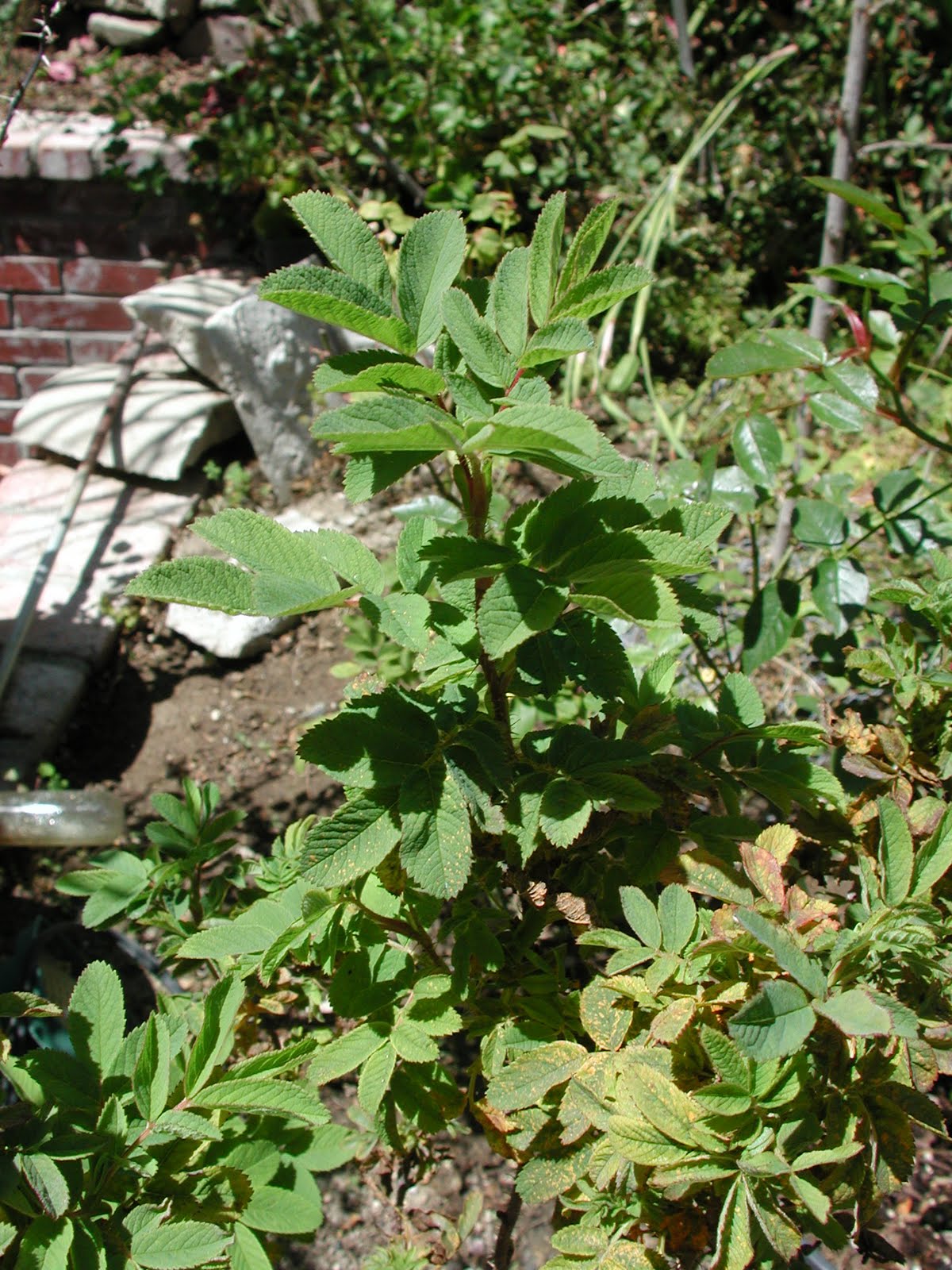
Permitting it to dry out seems to have mimicked Nature's not providing it with sufficient water in late summer and fall, causing the foliage to mature into its "old age" phase when it is most susceptible to rust infection. Rust causes what we consider premature foliage fall, but Nature's use for it is to cause the foliage to drop so the plant hardens off so it survives winter. I've been "confusing" the plant into thinking it should go into winter preparation mode, even though its growing season hasn't really happened yet.
I'm sure climatic suitability plays a part in the rust issue, too. I had observed in my old Newhall garden that Arkansana hybrids, except for Morden Blush, which was one of the most bullet-proof roses in that garden, weren't climatically suitable as they rusted very early in the season and continued rusting even when nothing else suffered the infection. A few of the Buck roses, notably Wandrin' Wind, suffered from extreme rust there, also.
Oddly, R. Arkansana "Peppermint" isn't affected by rust at all. It is planted in the ground about ten feet from the potted Arkansana, but it suffers from reflected heat and light off a white vinyl fence and has to battle asparagus fern and the resident mole, yet it grows cleanly and even flowered this spring.


Much has been written for a long time concerning the black spot susceptibility of roses bred from R. Foetida. What makes the most sense to me is genetic confusion.
Foetida is a deciduous plant. It has evolved where the greatest success requires forming its foliage early, using it up quickly, appropriate for the short growing season are it evolved in, then shedding it to prepare to winter without damage. We mixed these genes, with their associated immune system, with ever green genes from Tea and Hybrid Tea roses, which evolved in very long growing season areas. What resulted has been a line of roses which are genetically confused, with confused immune systems. The plant has instructions for creating its foliage quickly, using it up quickly so it may be shed to prepare for winter, combined with those telling it to hold that foliage the entire season. What results is foliage which quickly matures through its juvenility, rapidly becoming "senile", elderly, on a plant which refuses to shed it because the genetic information tells it to hold them like Teas and HTs do for longer growing seasons.
Rust and black spot are senility diseases, attacking "old" foliage to cause it to drop from the plant. The roses bred from Joseph Pernet's work with Foetida, those with red and yellow bi colored petals; brilliant yellows, oranges, scarlets and their blends; roses in 'tropical' colors such as shrimp, flamingo pink, "Peter Max" poster paint, neon colors, have this information programmed into them. They are the ones notorious for black spot and sometimes rust, infections.
The plants quickly form "senile" foliage, susceptible to the particular fungal attacks, much like my water stressed R. Arkansana is experiencing. We unnaturally selected roses with confused immune systems, and continue to attempt to select the better examples of that confused line in hopes of eliminating the confusion and producing healthy plants with the colors we desire. What we experience may well be not only what the plant is genetically programmed to do, but also what we unwittingly tell the plant to do through our culture, or lack of it.


