Friday, March 9, 2012

2012 Wrapping Update...


I wrapped my first cuttings Christmas Eve, with a second batch on New Years Day. All very good takes. I'm on the fifth batch now, having wrapped cuttings from a friend who potentially discovered a "lost" polyantha in her town. 


After some discussions and questions on Garden Web about a few points, I decided I should add a few photos to illustrate. 


No, you don't have to wait until there are actual roots to pot up the cuttings. Callus at this stage of development can work just fine. 
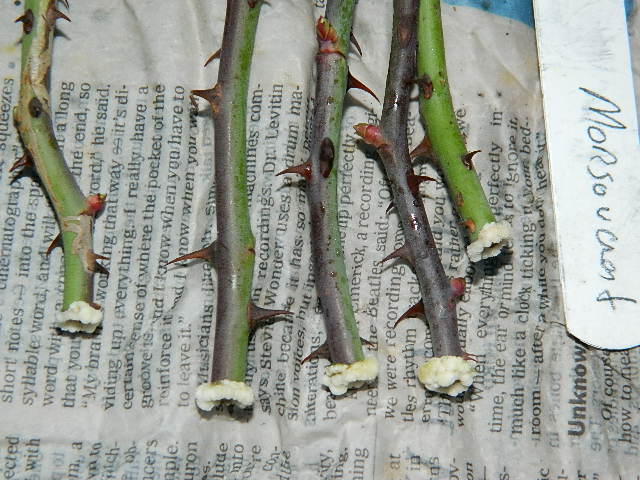


 Yes, you can wait until there are actual roots, but it seems the longer you permit them to sit in the dark, damp paper, the less likely they are to succeed. Until they are exposed to light so the green parts can photosynthesize their own food, they are operating on whatever levels of stored nutrients they contain. Permit them to use up their stores of food and they have nothing (or not enough) left to help carry them until they can push out roots to take up more resources.

Some find covering their cuttings with bottles, bags or placing them in a greenhouse or terrarium helps prevent them from drying out until they are rooted. If that works well in your conditions, great, but it hasn't worked for me here, at all. So, I plant them deeply in the cups, like this.


Most of the cutting is now encased in damp, cool, dark potting soil, much like when you mound or hill up a newly planted bare root. It works for both for the same reasons. Warmth and light stimulate growth buds to develop, resulting in new leaves and canes, often to the point of flowering, whether there are sufficient roots to support the plant or not. 

Encasing the cutting or newly planted bare root in soil, only permitting the top few inches to be exposed to the heat, dry and light, keeps the cutting or plant cool, darker and damper which stimulates root growth instead of cane, leaf and flower. This has successfully permitted several hundred wrapped cuttings to continue rooting and developing for me this and last year. 

As I see roots filling the bottom inch or so of soil, and top growth being produced, they finally reach the stage where I'm comfortable lifting them in their pots so more cane is exposed and more soil area provided for more root development. It's an easy shift to make. 

I tilt the soil ball out of the cup, add enough soil to the cup to elevate the cutting so it will be situated in the cup at what should be the proper planting height, then set the bottom of the soil ball back in the cup. Gently pull the soil around the cane above the root area away from the cane as you push it into the cup to fill in around the roots and soil. You're really just trading spaces it occupied from above the roots along the cutting, to below the roots where it permits more root growth room. 

Until now, that extra soil kept the cutting dark, cool and damp while it rooted. Now it can be exposed to the hotter, drier, brighter conditions without having to harden it off as would be required had the cutting been covered by plastic or bottles, or grown in a greenhouse or terrarium.

Monday, January 2, 2012

Solanum pyracanthum

Last year, I posted for help identifying a real "Tim Burton" like weed which was identified as Buffalo Burr. This one is a deliberate addition because I just like it. Nothing seems to eat it...yet, though I know being a Solanum, it's likely quite toxic. But, the spines are beautiful, even if they eminiate from every plant surface. They glow in the direct sun much like the prickles on R. Omeiensis pteracantha. Like that rose, it does feel very prehistoric. I find it rather sculptural and very interesting. Besides, with a common name of "Devil's Tomato", how could I resist?

I've been told to watch it as it can help itself to the entire hill, though in over a year, only one seedling has volunteered. Even when I harvested the small, green "tomatoes" it forms from each flower and deliberately planted the seed, only one germinated and has gone to 'grace' a friend's garden. The seedling has grown to an amazing size, probably due to his fertile potting soil and partial shade he's provided, but here in this 'dirt' and in harsher conditions, both are remaining under two feet...so far...


It belongs here, it DOES have "thorns".

Sunday, December 11, 2011

Flower cluster propagation update

In an earlier entry, I showed how I'd rooted a flower cluster, the type of growth quite often disparaged for propagation as it supposedly doesn't contain growth buds. This is what that bloom cluster of Shadow Dancer looked like today, not quite a year since it rooted, when I planted it in the yard. 

The actual flowering part is to the right, the new cane, in all its thorny glory, is the one on the left. 
 That's a two gallon nursery can it's planted in.
 Not bad growth from a less than a year old rooted plant, particularly from growth most often dismissed as unsuitable for propagation.

The "terrace" down hill is for seedlings and the ever-present alyssum. The stuff grows like fire, but nothing eats it and it keeps the other weeds down. The wire basket is to inhibit the mole I haven't yet been able to send to his reward.


Saturday, October 29, 2011

Wrapping refresher...

Now the weather is finally cooling, many of us can begin experimenting with wrapping cuttings. There are a few questions which have been presented to me, so I'll attempt to answer them here, with all I've discovered here in my climate.

1. The best wood is that which has over wintered, hardened off and stored enough nutrition to break dormancy in spring. Wrapping cuttings which are fresh flowering stems hasn't been successful in many cases based upon those who have written me and in my own attempts. The wood has to contain enough stored food to permit it to callus, form roots and begin life as an independent plant. Stems grown this year, whether it has flowered or not, have, in most experiences reported to me as well as my own, proved too soft and failed. Wood grown last year and carried over winter is the best for this method.

2.  It appears the most beneficial temperature range to hold the wrapped cuttings under is between the low fifties to mid to upper sixties degrees F. Too high and they won't callus, and may either dry out quickly or even rot. Too low and they preserve like produce in your vegetable crisper, without callusing.

3.  From experiences reported to me and my own, it appears if the cuttings aren't going to callus within the initial two weeks of being wrapped, leaving them longer reduces the probability they are going to callus at all. Of course, you may experiment, leaving them as long as you wish, but from reports and observations, two weeks is the optimum time, at the optimum temperatures.

4.  You MUST remove all the foliage from all of the cuttings, PERIOD. Leaves wrapped in the damp paper can both cause the cuttings to dry out as well as rot. You are dealing with hard wood cuttings. These are best dealt with bare, no foliage left on them.

5.  You may remove the prickles if you wish. You don't have to remove the prickles if you don't want to. Removing them, if possible, can expose more cambium layer, which can then callus and eventually form roots. Removing them, if possible, can also make handling the cuttings nicer and prevent the damp paper from being damaged and hanging on to the cuttings when removing them from the wraps. This part is completely up to you.

6.  You do not have to treat the entire cutting with rooting hormone. You treat the bottom end, the end you expect to form roots. Other exposed sections of cambium can form callus and roots along the cutting. You may, if you wish, cut the cutting up to make use of the places it is forming roots, or, you may simply plant it as deeply as you wish to form roots anywhere it wants. Again, up to you.

7.  The length of cutting is up to you. I intend to experiment this winter/spring using one and two bud long cuttings to see just how much is necessary for the method to work. I've already demonstrated you can root whips up to nearly four feet long of suitable types for standard trunks. I also want to experiment with my VI Fortuniana to see if precallusing them can make the bloody things root more easily. If you're intending on rooting stocks for budding this summer, this may give you a leg-up getting your material ready.

Sunday, September 25, 2011

Oh, Goodness!

Oh Goodness! A friend emailed me this evening to alert me I am now "famous"? She discovered I am now listed as a "Reference" about the rose Iceberg on Wikipedia! Scroll down to the Reference section and you will find my article, "Poor Old Iceberg", published on Help Me Find-Roses. Is that a hoot, or what?

Wikipedia article about Iceberg

Wednesday, August 24, 2011

Hot Weather Wrapping

I've had several questions about success rates, or lack thereof, using this method in hot weather. I'm also finding high heat not only disadvantageous to wrapping itself, but also in succeeding in bringing them from the callus stage to a rooted plant.

I'm doing my best not to use extra electricity this summer running the air conditioning when regulating windows and fans are keeping it livable. The extra 50% increase in power costs to artificially cool the place really makes a difference! The extra power also offends my sustainability senses. Whatever the source of the power being used to create the electricity, I'm not sure I want to use it, saving it for when I can't get by OK without it. So far, so good.

All this is shared to explain this...even the lovely, dark, cool work room isn't able to remain in the temperature range I've found most beneficial for callusing without using the a/c to keep it there. My experiments with refrigerating cuttings haven't been any better than the reports I've received. I'm not sure if the average fridge keeps them too cold for callus to form, but that is seeming the case. I don't have any kind of root cellar nor anywhere to create a temporary one which might provide the appropriate temperatures required, so I'm waiting until cooler weather periods to wrap any more material.

Even if I could successfully callus cuttings now, the heat we're experiencing is not conducive to being able to carry them further. When day temps remained around eighty degrees F or lower, it wasn't an issue. They formed their roots and began growing acceptably. Those patterns are gone for a while. Today, it's supposed to be 104 F here, with up to 107 by the end of the week, and they're threatening to add humidity to the mix, something we traditionally don't have to worry much about.

These hotter temperatures have sucked the life out of many of the cuttings which had successfully callused not that long ago. There are several potential causes I can think of.

It appears more dormant to semi dormant material calluses more successfully than softer, more actively growing ones do. Perhaps it's due to their containing higher levels of nutrients stored in the wood which would otherwise have been used to break dormancy when the weather triggered it? It could be the softer material doesn't have these stored resources and are more susceptible to using up what they do have just to remain alive and aren't able to form the necessary roots before they collapse. Almost like trying to force a bare root into growth too quickly, stimulating it to use up its stored resources to leaf out, form flowers and collapse. I've had many soft wood cuttings during the hotter summer months using other methods leaf out, set blooms and die, so the pattern seems to hold.

Perhaps the softer, more actively growing material has too high levels of auxins and hormones which stimulate the faster growth at the expense of rooting? My experiences using mist propagation showed the actively growing cuttings rooted in as little as seven to ten days from stems which had just dropped their flowers this time of the year. Harder wood cuttings often wouldn't root under mist in weather like this, but would root in winter at much slower rates, sometimes all winter. Those cuttings were under a regular mist of fog which prevented them from drying out and scorching and were in full sun so all green parts of the cutting were providing photosynthesis to maintain it while it formed roots and began supporting itself. Wrapping the way I have been doesn't provide the mist or very high humidity, and I have found planting the cuttings deeply in the cups or pots prevented them from drying out before the roots formed. This would reduce their ability to provide themselves food via photosynthesis while they root.

It could be there are pathogens at work we don't see as much when temperatures are lower. Botrytis and Downey Mildew can both significantly reduce the success rate of propagation no matter what method you use. Some of the results have almost looked like Fire Blight on some of the cuttings. The weather has been suitable for that issue, cool and damp, hotter and damp, repeat. The evergreen Pears are definitely showing those effects in the neighborhood.

I don't spray anything. Not a value judgement if you do as I know there are many environments you can't grow roses in without chemical assistance. Spraying just doesn't fit in with my climate, wind, allergies and sensitivities, nor budget. If it won't grow here without chemical intervention, it isn't going to hang around long. I won't spend the money for them and I'm sure not going to spend the money on doctors visits resulting from the reactions I have to chemicals with increasing regularity.

It might be possible to prevent whatever potential pathogen might be at work on the cuttings by spraying with a fungicide, or not. I won't know as I don't own any fungicides. I can't spray any with these temperatures and wind and I'm not willing to experience any potential effects I might (probably will) have from exposure to them. If you are exploring this method in a hotter area and having the same disappointing low to zero success rate and you spray, please consider including the cuttings in your regimen and report back what the results were. It might make important contributions to the knowledge base about it.

I think I'm also finding specific varietal differences to wrapping in hot weather as I know to be the case in cooler weather. The last batch of unnamed China cuttings I callused and planted have had significantly different results from each other. One rooted and began developing into viable plants, at a much lower percentage of success than earlier in cooler, damper weather, but they have seemed willing to perform. The other, handled and treated exactly the same as the first and done at the same time, limped along, complaining the entire time and all but one cutting has turned black and failed. The jury is still out on the lone survivor. Perhaps the second variety just isn't as successful at creating its own roots and possibly would be better budded than own root? Perhaps it isn't as forgiving about being pushed to root in hot weather as the first? Maybe it had a higher level of pathogen exposure then the other? I honestly don't know. This is definitely going to take a lot more exploration, experimentation and observation.

I will be very interested hearing others' experiences from other climates and from those who spray and will include the cuttings in their spray program. None of us can provide all the potential variations in climate, culture or potential fungi and bacteria. Pooling the results and observations should help to lead to the discoveries of what may work in these hotter times. At least, I hope so and I'll definitely enjoy hearing others' experiences, theories and results. Stay tuned!

Saturday, August 20, 2011

Amazing!

I had the pleasure this afternoon of visiting a great friend in his garden not too far from my home. While we sat on his patio talking roses (something neither of us can ever get too much of!), surrounded by his wonderful collection of rare and unusual roses, my eye kept being drawn to this mauve rose I could not identify.


I asked him what on earth it was and he looked at me rather startled! He said, "You SHOULD know that rose!" It is one of my seedlings, introduced years ago by Ashdown Roses as "Purple Poly Seedling" and later named for a friend's daughter (and my middle name), Lauren.

It looks nothing like what my plant of it looks like just a few miles west of where this one grows. But, then, I have less of the coastal fog influence than he does. My area is several degrees hotter than his and my plant blisters in full, all day sun, western exposure, where his is under lathe, receiving more filtered and indirect light. Mine is planted in native "dirt" while his grows in good potting soil, in a pot and watered much more religiously.

This is what I'm used to seeing here. Significantly smaller flowers with appropriately smaller petals as well as smaller, harder foliage.


This is what it looks like today in the higher heat.


I emailed him this photo when I got home. He responded, "It is amazing how much the same rose can differ from one location to the next. I wonder that any roses are ever identified, given that fact. And it explains how Smith sold William R Smith exclusively to 9 different guys."