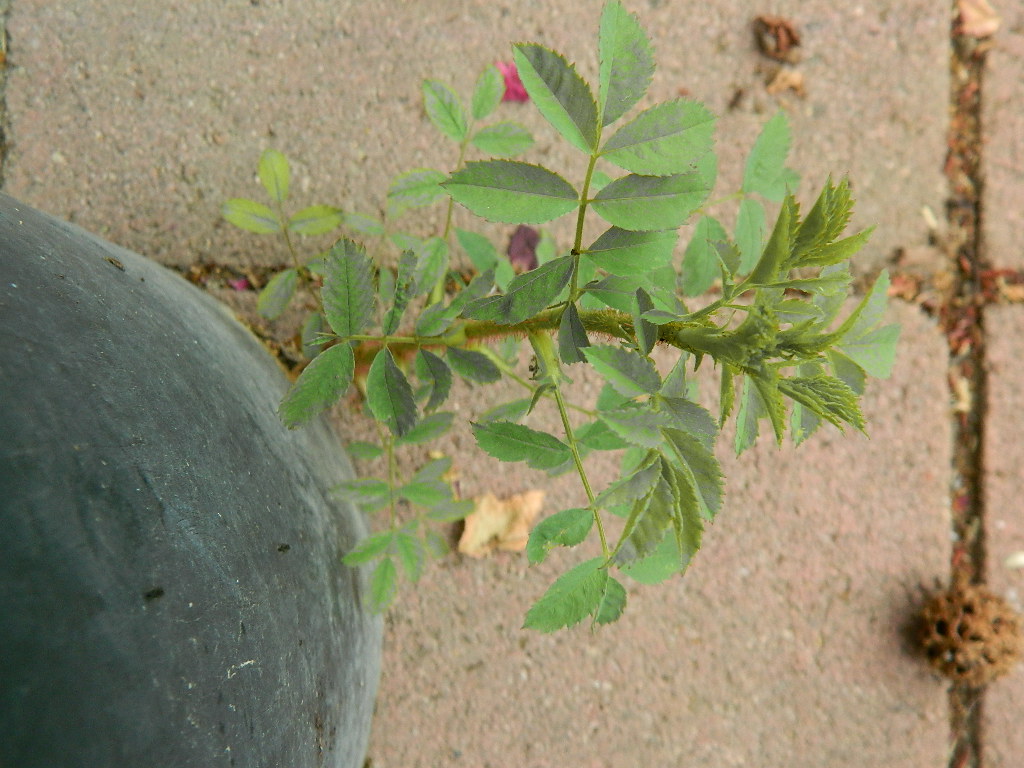
I tried raising seedlings from the very few seeds R. Stellata Mirifica produced for years with no results. My plant was quickly growing backwards as it hated the place I had it on the hot, dry hill in Encino. It seemed to "know" it was not long for this world as it set more hips and seeds than it ever had. I planted them all and two seedlings resulted. One is very Stellata-like, only with foliage that is a bit too sensitive for the high UV here on the coast. The other is a "Puzzlement".
I've chosen to call this seedling Puzzlement because it is quite a puzzle. The seed was absolutely from Stellata mirifica. Only two seedlings germinated from all those final self set seed the plant produced as it died. There as nothing overhanging the seed tables and these were the only species seeds planted in that end of the table to avoid any mix-ups. All those surrounding them were from modern X modern crosses. This one is NOT a "modern" seedling.
R. Fedtschenkoana grew just a few feet from Stellata mirifica and Puzzlement looks for all the world like a natural hybrid between the two.
It seems to have inherited the flower color and more rounded foliage from Stellata with the general coloring of the plant and growth habit, as well as the summer-long flowering from Fedtschenkoana. Stellata mirifica scattered its flowers over summer, with not quite as frequent, nor as heavy flowering as Fedtschenkoana. Puzzlement first flowered in late August of its first year (2011) and has scattered flowers virtually continuously since.
Unlike either suspected parent, it has smooth ovaries and sepals and, unlike either parent, there doesn't seem to be much scent. Fedtschenkoana in my climate, will set some self set hips. Mirifica set even fewer. Puzzlement so far, sets none. But, its pollen is fertile! It doesn't release much, so it requires as many flowers as are available to get enough to do much with.
Jim Sproul shared a very healthy, deep, bright, saturated red single seedling with me several years ago.
It's incredibly fertile and seems to breed with nearly anything I pollinate it with. The first hybrids with Puzzlement pollen have resulted from this single, red mini.
There are several seedlings showing varying levels of hybridity. They range from extremely glossy, dark green foliage like the seed parent, only with climbing, prickle-free stems to heavily textured, embossed green foliage with less gloss and well armed with very sharp prickles. More on these as they grow after transplanting from the seed tables.
One of the prickle-free seedlings is now flowering for the first time, just five months from the seed being planted! It has foliage quite like the miniature seed parent, except for its total lack of prickles and its extremely vigorous, almost climbing habit. Puzzlement is a pastel pink. The seed parent is brilliant, saturated deep red. This seedling is a light pink and also single.
There is actually a sweet scent, something neither parent is very strong on. Several of the cane tips terminate in three and four buds. I don't know how these may be for breeding, nor really even what traits they may possess worth using, but they certainly are interesting and fun!
Friday, September 25, 2015
Thursday, April 23, 2015
Grey Pearl
This rose created a sensation when first introduced seventy years ago. Then, as now, people either found it irresistible or they loathed it. And, that was simply based upon its flower. Those who got to know it intimately, eventually learned to loathe the awful plant under that unusual flower. Jackson and Perkins imported the rose from the House of McGredy, in Ireland. There, due to its shy growing plant and grayish coloring, they had nicknamed it "The Mouse". Gene Boerner received the comment that it reminded the viewer of gray pearls. The Wisconsin farmer dressed up and visited a famous New York jeweler asking to see gray pearl shirt studs. He asked their price and was told they were $3,000. Remember, this was right about the end of World War 11. He conjectured if people were willing to pay $3,000 to wear gray pearl shirt studs, surely they would pony up the $2.00 per plant to grow it in their gardens?
Roses of Yesterday and Today was this rose's champion for several decades. All through the 1950s and 1960s, they touted how glorious the color of the flowers was, then apologized they, once again, were unable to provide plants as they simply refused to grow.
I had read the description in Modern Roses 8.."chocolate, olive, saffron and tan". I HAD to grow it! The Combined Rose List reported only ONE source for Grey Pearl in the world. Marissa Fishman at Greenmantle Nursery in Garberville, CA courageously attempted to offer it. I placed my order for two, as she had warned me the plant had a "death gene". It will slowly build, then throw a strong basal, topped with up to twelve of the most glorious flowers, then die to the root. She suggested the only way to maintain it in a garden or collection was to grow multiples, permitting one to flower some, while keeping all flower buds pinched off the second until it developed into the hoped-for plant size, then reverse the process. She required a year to produce my two plants, but they finally arrived and were very neurotically worried over.
Of course, I had to allow them to flower! I had waited so long to finally see a "chocolate, olive, saffron and tan" rose, those buds simply MUST be allowed to open. In the high heat and brilliant sun of the San Fernando Valley, I saw little of those legendary tints. The flower was a dirty, pale lavender, generously washed over with dirty dish water. Yum! She was right. The only way to keep it going was to have more than one and not allow it to flower itself to death.
While it wasn't a 'strong' plant, it was healthy. In all the years I had it, none of my plants every expressed any fungal issues. The only one with any diseases I'd encountered were the plants grown in the greenhouses at Sequoia Nursery. In the open, the foliage was always completely clean. Under plastic, they mildewed.
During the late 80s and into the 90s, I actually had two "versions" of the rose. Liggett's Nursery sold the one The Huntington Library grew. It had (as this one does) yellow petal bases with a slight yellow wash over the petals. I tagged it as "Huntington-Liggett clone". The Greenmantle rose had white petal bases with no yellow tints to the flower. I tagged that one the "Greenmantle clone". The last plant of the Greenmantle Grey Pearl I knew of grew in Barney Gardner's garden in Los Banos, CA. I took it to him from my garden before I lost my last plant of it. There is no hope of it existing there as Barney passed in 2007. He owned an enormous lot with a huge old house, just a block off the main street. I'm certain it's been cleaned up and the rose would have required extra attention just to survive.
I watched one of my two latest budded Grey Pearls decide it was time to go to the "Great Beyond". It began dying back and didn't slow down until the symptoms reached the bud union. The other plant languished. I determined that if it died, I would not attempt to replace it. The plant continued shrinking until it finally responded to something, and threw about a six inch cane. I had rooted stocks of both Pink Clouds and VI Fortuniana, and I figured nothing ventured, nothing gained. I used the only buds available from the shrinking plant to produce one plant on Fortuniana and one on Pink Clouds. If only one survived, at least it wasn't gone yet. If both survived, I could possibly test which stock was better suited to the rose. Fortunately, both survived. The older, shrinking budded plant died.
Grey Pearl is NOT a "great" plant. It has been offered own root, and it can be grown (for a little while) on its own roots, but not very well. Even budded, it requires propagating new plants regularly just to keep it alive. This photo on Help Me Find-Roses, I took at Sequoia Nursery years ago. The large plant in the rear of the photo is a budded Grey Pearl. The yellowish, smaller plant in the foreground is an own root. Both were propagated from the same plant, at the same time, in the same green house; grown in the same soil and received the same treatment.
The Pink Clouds plant grew much more vigorously than the plant on Fortuniana. I watched both religiously to make sure nothing happened to them. While the one on Pink Clouds pushed new growth and a flower, the plant on Fortuniana simply sat there, doing nothing. This was thirteen months ago, back in mid June. After my recent move, the Pink Clouds plant defoliated and began pushing new growth from every bud, something Grey Pearl is notorious for doing just before it collapses and dies. The Fortuniana plant has developed more slowly into quite a nice specimen. It pushed one bud on a straight, strong stem, which I permitted to flower. I HAD to!
Grey Pearl on Pink Clouds, budded June 16, 2014
On VI Fortuniana, budded within minutes of the Pink Clouds plant.
I obsessively shot over one hundred photos of the plant, bud and opening flower over the several weeks it required to finally open. Those tints are extremely difficult to capture!
I tore up that one flower to pollinate it with a Banksiae X Laevigata cross. There were 59 petals and petaloids! Love it, or hate it, Grey Pearl really is something completely different!
Roses of Yesterday and Today was this rose's champion for several decades. All through the 1950s and 1960s, they touted how glorious the color of the flowers was, then apologized they, once again, were unable to provide plants as they simply refused to grow.
I had read the description in Modern Roses 8.."chocolate, olive, saffron and tan". I HAD to grow it! The Combined Rose List reported only ONE source for Grey Pearl in the world. Marissa Fishman at Greenmantle Nursery in Garberville, CA courageously attempted to offer it. I placed my order for two, as she had warned me the plant had a "death gene". It will slowly build, then throw a strong basal, topped with up to twelve of the most glorious flowers, then die to the root. She suggested the only way to maintain it in a garden or collection was to grow multiples, permitting one to flower some, while keeping all flower buds pinched off the second until it developed into the hoped-for plant size, then reverse the process. She required a year to produce my two plants, but they finally arrived and were very neurotically worried over.
Of course, I had to allow them to flower! I had waited so long to finally see a "chocolate, olive, saffron and tan" rose, those buds simply MUST be allowed to open. In the high heat and brilliant sun of the San Fernando Valley, I saw little of those legendary tints. The flower was a dirty, pale lavender, generously washed over with dirty dish water. Yum! She was right. The only way to keep it going was to have more than one and not allow it to flower itself to death.
While it wasn't a 'strong' plant, it was healthy. In all the years I had it, none of my plants every expressed any fungal issues. The only one with any diseases I'd encountered were the plants grown in the greenhouses at Sequoia Nursery. In the open, the foliage was always completely clean. Under plastic, they mildewed.
During the late 80s and into the 90s, I actually had two "versions" of the rose. Liggett's Nursery sold the one The Huntington Library grew. It had (as this one does) yellow petal bases with a slight yellow wash over the petals. I tagged it as "Huntington-Liggett clone". The Greenmantle rose had white petal bases with no yellow tints to the flower. I tagged that one the "Greenmantle clone". The last plant of the Greenmantle Grey Pearl I knew of grew in Barney Gardner's garden in Los Banos, CA. I took it to him from my garden before I lost my last plant of it. There is no hope of it existing there as Barney passed in 2007. He owned an enormous lot with a huge old house, just a block off the main street. I'm certain it's been cleaned up and the rose would have required extra attention just to survive.
I watched one of my two latest budded Grey Pearls decide it was time to go to the "Great Beyond". It began dying back and didn't slow down until the symptoms reached the bud union. The other plant languished. I determined that if it died, I would not attempt to replace it. The plant continued shrinking until it finally responded to something, and threw about a six inch cane. I had rooted stocks of both Pink Clouds and VI Fortuniana, and I figured nothing ventured, nothing gained. I used the only buds available from the shrinking plant to produce one plant on Fortuniana and one on Pink Clouds. If only one survived, at least it wasn't gone yet. If both survived, I could possibly test which stock was better suited to the rose. Fortunately, both survived. The older, shrinking budded plant died.
Grey Pearl is NOT a "great" plant. It has been offered own root, and it can be grown (for a little while) on its own roots, but not very well. Even budded, it requires propagating new plants regularly just to keep it alive. This photo on Help Me Find-Roses, I took at Sequoia Nursery years ago. The large plant in the rear of the photo is a budded Grey Pearl. The yellowish, smaller plant in the foreground is an own root. Both were propagated from the same plant, at the same time, in the same green house; grown in the same soil and received the same treatment.
The Pink Clouds plant grew much more vigorously than the plant on Fortuniana. I watched both religiously to make sure nothing happened to them. While the one on Pink Clouds pushed new growth and a flower, the plant on Fortuniana simply sat there, doing nothing. This was thirteen months ago, back in mid June. After my recent move, the Pink Clouds plant defoliated and began pushing new growth from every bud, something Grey Pearl is notorious for doing just before it collapses and dies. The Fortuniana plant has developed more slowly into quite a nice specimen. It pushed one bud on a straight, strong stem, which I permitted to flower. I HAD to!
Grey Pearl on Pink Clouds, budded June 16, 2014
On VI Fortuniana, budded within minutes of the Pink Clouds plant.
I obsessively shot over one hundred photos of the plant, bud and opening flower over the several weeks it required to finally open. Those tints are extremely difficult to capture!
I tore up that one flower to pollinate it with a Banksiae X Laevigata cross. There were 59 petals and petaloids! Love it, or hate it, Grey Pearl really is something completely different!
Tuesday, April 21, 2015
What herb is this?
I recently moved to the Central California Coast, but had to be back in the "old stomping grounds" for business. I HAD to visit Green Thumb/Green Arrow Nurseries as they had been my primary "go to source" for all the neat, weird and wonderful plants needed for my gardens.
Of course, since their closest store is now almost two hours from me, one of the plants which followed me home came without a label. It was on the herb rack, right beside the Helichrysum italicum, Curry Plant and resembles it slightly. Its tag stated it also has the "curry" flavor and can actually be used to season food as it is edible, where the Helichrysum isn't. Now, I need to find the identity of the edible "Curry Plant". Any thoughts? Thank you!
Helichrysum italicum
Of course, since their closest store is now almost two hours from me, one of the plants which followed me home came without a label. It was on the herb rack, right beside the Helichrysum italicum, Curry Plant and resembles it slightly. Its tag stated it also has the "curry" flavor and can actually be used to season food as it is edible, where the Helichrysum isn't. Now, I need to find the identity of the edible "Curry Plant". Any thoughts? Thank you!
Helichrysum italicum
This is the supposedly edible "Curry Plant". It sort of reminds me of a type of Buckwheat, but it definitely has a "curry" type scent to the foliage.
Monday, April 13, 2015
"Hybrid Musks, Climbing Polyanthas and Polyanthas"
There is much confusion over what differentiates Hybrid Musk roses, climbing polyanthas, and polyanthas. The confusion stems from the fact that all three classifications are mostly hybrids of the same species.
Hybrid Musks:
As is often the case, first we have to unlearn. Hybrid Musk’ roses actually have no proven connection with ‘R. Moschata,’ the “Musk Rose”. The Hybrid Musk class is based upon the Hybrid Multiflora, ‘Aglaia,’which resulted from a cross of R. Multiflora with ‘Reve d’Or.’ The latter has been classed as a Noisette since its introduction in 1869. All that is known of its origin for certain is it is a seedling of ‘Mme. Schultz,’ which was presumed to be a Noisette, though nothing is known for sure of her origin. As early as 1857, in The ScottishGardener; a magazine of horticulture and floriculture, ‘Mme. Schultz’ was described as being “in the way of Lamarque”, meaning she resembled what had become accepted as Noisettes, a cross between Moschata and China Roses. If we presume ‘Mme. Schultz’ was half Moschata (Musk), then ‘Reve d’Or’ was at most half Musk.’ Aglaia’ would then be one-quarter (at most) Musk and one half Multiflora, and has always been classed as a Hybrid Multiflora. Hybrid Musk roses, then, are primarily Hybrid Multifloras. They could be viewed in terms of being smaller, repeat flowering Multiflora Ramblers.
Climbing Polyanthas:
R. Multiflora is basically a climbing plant. From observation of the many self-seedlings and known hybrids, it carries dwarf, repeat flowering genes which can be expressed when the right combinations are made. “The Fairy Roses”, “Baby Roses” or R. Multiflora perpetual nana, which have long been sold as seed, are examples of dwarf, repeat flowering seedlings from it, and are classed as Hybrid Multiflora. Though they often resemble “The Gift”, which is classed as a Polyantha, they remain Hybrid Multiflora.
Polyanthas:
‘Mignonette’ and ‘Pacquerette’ are generally considered the first of the new breed of roses called Polyanthas. They resulted from crosses between R. Multiflora and China Roses. These roses created quite a sensation when first introduced. Quickly, many breeders were raising self-seedlings from them or crossing them with Teas, Hybrid Perpetuals, other Multiflora ramblers and Hybrid Multifloras to raise new additions to the polyantha class.
The German hybridizer, Peter Lambert crossed ‘Aglaia’ (Hybrid Multiflora) with the Hybrid Perpetual, ‘Mrs. R. G. Sharman-Crawford’ to create ‘Trier’ (Hybrid Multiflora). Suddenly, crosses of the Hybrid Multiflora “Trier” with Hybrid Teas, Hybrid Perpetuals, Teas and Floribundas, began creating Hybrid Musk roses. But, remember, ‘Trier’ is presumed to be, at most, one-eighth Musk, and known to be one-quarter Multiflora.
Most Hybrid Musks of known parentage arose from either crosses with Trier or direct crosses with R. Multiflora through ‘Ballerina’, which is virtually pure Multiflora. Peter Lambert’s Hybrid Multiflora, ‘Trier,’ was quite busy at the same time. Not only Lambert, but many others were busily crossing Trier with all manner of roses from R. Foetida, Teas, Hybrid Perpetuals to other Polyantha seedlings raising more polyanthas and a new class of roses named "Lambertianas," to honor Lambert and to describe roses that seemed to have something in common. These Lambertiana roses were basically more vigorous semi-climbing to climbing polyanthas. Shorter growing than the traditional Hybrid Multiflora rambler, and with repeat flowering, these roses were the bridge between the Hybrid Multiflora and Polyantha classes. In many ways, they could be considered Climbing Polyanthas.
Polyanthas continued being developed toward bushier, more densely flowering plants with increasingly larger individual flowers. Crosses with Teas, Hybrid Perpetuals and Hybrid Teas reduced the cluster sizes, but increased the size of the flowers until the introduction of the Hybrid Polyantha class, later called Floribundas. As the class developed, cluster size reduced and individual flower size increased similarly to the development in the Polyantha class. Often, the same roses were crossed with the Multiflora hybrids to create both types.
Lambertianas were less vigorous “Hybrid Musks” with generally smaller flowers, but still semi-climbing to climbing habit and repeat flowering. Polyanthas are dwarf, repeat to continuous flowering hybrids of the same roses which created Hybrid Musks and “Lambertianas”.
As was previously mentioned, R. Multiflora is a climbing type plant. Like most roses, it can mutate or sport, often to climbing forms. Climbing sports of Polyanthas often resemble repeat flowering Multiflora Ramblers, Lambertianas, even Hybrid Musks, as well they should. They all contain strong Multiflora influences, massaged by China, Tea, Hybrid Perpetual and Hybrid Tea genes. For all intents and purposes, they’re all Hybrid Multifloras. Attempts to “classify” them have predominantly been based on, “if it quacks like a duck…” Even though they all are strongly genetically related, if one “looks” as if we expect a polyantha to appear, we consider it a polyantha. The same holds true for the other two “types”, even though they are all Multiflora hybrids.
Hybrid Musks:
As is often the case, first we have to unlearn. Hybrid Musk’ roses actually have no proven connection with ‘R. Moschata,’ the “Musk Rose”. The Hybrid Musk class is based upon the Hybrid Multiflora, ‘Aglaia,’which resulted from a cross of R. Multiflora with ‘Reve d’Or.’ The latter has been classed as a Noisette since its introduction in 1869. All that is known of its origin for certain is it is a seedling of ‘Mme. Schultz,’ which was presumed to be a Noisette, though nothing is known for sure of her origin. As early as 1857, in The ScottishGardener; a magazine of horticulture and floriculture, ‘Mme. Schultz’ was described as being “in the way of Lamarque”, meaning she resembled what had become accepted as Noisettes, a cross between Moschata and China Roses. If we presume ‘Mme. Schultz’ was half Moschata (Musk), then ‘Reve d’Or’ was at most half Musk.’ Aglaia’ would then be one-quarter (at most) Musk and one half Multiflora, and has always been classed as a Hybrid Multiflora. Hybrid Musk roses, then, are primarily Hybrid Multifloras. They could be viewed in terms of being smaller, repeat flowering Multiflora Ramblers.
Climbing Polyanthas:
R. Multiflora is basically a climbing plant. From observation of the many self-seedlings and known hybrids, it carries dwarf, repeat flowering genes which can be expressed when the right combinations are made. “The Fairy Roses”, “Baby Roses” or R. Multiflora perpetual nana, which have long been sold as seed, are examples of dwarf, repeat flowering seedlings from it, and are classed as Hybrid Multiflora. Though they often resemble “The Gift”, which is classed as a Polyantha, they remain Hybrid Multiflora.
Polyanthas:
‘Mignonette’ and ‘Pacquerette’ are generally considered the first of the new breed of roses called Polyanthas. They resulted from crosses between R. Multiflora and China Roses. These roses created quite a sensation when first introduced. Quickly, many breeders were raising self-seedlings from them or crossing them with Teas, Hybrid Perpetuals, other Multiflora ramblers and Hybrid Multifloras to raise new additions to the polyantha class.
The German hybridizer, Peter Lambert crossed ‘Aglaia’ (Hybrid Multiflora) with the Hybrid Perpetual, ‘Mrs. R. G. Sharman-Crawford’ to create ‘Trier’ (Hybrid Multiflora). Suddenly, crosses of the Hybrid Multiflora “Trier” with Hybrid Teas, Hybrid Perpetuals, Teas and Floribundas, began creating Hybrid Musk roses. But, remember, ‘Trier’ is presumed to be, at most, one-eighth Musk, and known to be one-quarter Multiflora.
Most Hybrid Musks of known parentage arose from either crosses with Trier or direct crosses with R. Multiflora through ‘Ballerina’, which is virtually pure Multiflora. Peter Lambert’s Hybrid Multiflora, ‘Trier,’ was quite busy at the same time. Not only Lambert, but many others were busily crossing Trier with all manner of roses from R. Foetida, Teas, Hybrid Perpetuals to other Polyantha seedlings raising more polyanthas and a new class of roses named "Lambertianas," to honor Lambert and to describe roses that seemed to have something in common. These Lambertiana roses were basically more vigorous semi-climbing to climbing polyanthas. Shorter growing than the traditional Hybrid Multiflora rambler, and with repeat flowering, these roses were the bridge between the Hybrid Multiflora and Polyantha classes. In many ways, they could be considered Climbing Polyanthas.
Polyanthas continued being developed toward bushier, more densely flowering plants with increasingly larger individual flowers. Crosses with Teas, Hybrid Perpetuals and Hybrid Teas reduced the cluster sizes, but increased the size of the flowers until the introduction of the Hybrid Polyantha class, later called Floribundas. As the class developed, cluster size reduced and individual flower size increased similarly to the development in the Polyantha class. Often, the same roses were crossed with the Multiflora hybrids to create both types.
Lambertianas were less vigorous “Hybrid Musks” with generally smaller flowers, but still semi-climbing to climbing habit and repeat flowering. Polyanthas are dwarf, repeat to continuous flowering hybrids of the same roses which created Hybrid Musks and “Lambertianas”.
As was previously mentioned, R. Multiflora is a climbing type plant. Like most roses, it can mutate or sport, often to climbing forms. Climbing sports of Polyanthas often resemble repeat flowering Multiflora Ramblers, Lambertianas, even Hybrid Musks, as well they should. They all contain strong Multiflora influences, massaged by China, Tea, Hybrid Perpetual and Hybrid Tea genes. For all intents and purposes, they’re all Hybrid Multifloras. Attempts to “classify” them have predominantly been based on, “if it quacks like a duck…” Even though they all are strongly genetically related, if one “looks” as if we expect a polyantha to appear, we consider it a polyantha. The same holds true for the other two “types”, even though they are all Multiflora hybrids.
Sunday, March 29, 2015
Seedling tables
In an earlier post, I showed how to collect pollen and use it to fertilize blooms to produce seeds of your own crosses. After approximately 110 or so days after pollination, they should be sufficiently ripe for either storing until the weather is appropriate for planting, or sowing directly into soil if the temperatures are right.
It's an easy task to harvest and store seeds. Open the ripe hip with whatever works best for you, scissors, a small knife, whatever you want to use. Remove the seeds and rub the fibers and any hip tissue from them, then place in small plastic bags with the label recording the cross, and store it in the refrigerator until ready to plant.
Once you are ready to plant rose seeds, you'll need something to plant them in. Of course, you can use pretty much anything you have handy and want to use, but if you have many seeds to find soil for and experience some more extreme heat and aridity issues, something along these lines may be just "what the doctor ordered".
I wanted something I could protect against slugs, snails, rabbits, rodents, squirrels and the birds who love to dig up seeds and unearth seedlings. I also wanted a method of permitting them to grow outdoors in full sun without having to worry they would dry out and fry quickly. Because I have to allow them to continue growing in the seed tables all summer until the weather is appropriate for me to transplant them individually, and clean out the tables for the next crop of seeds, I wanted something with sufficient soil to hold enough water for many vigorous seedlings at one time, particularly over the hotter, drier months.
I also wanted something readily available and at "friendly cost". Browsing my local "home improvement store" yielded the idea of using fir fencing boards. They're 8" wide and available in 6' and 8' lengths. I could also find very green, wet boards, making them easier to keep watered as the wetter wood seems to draw less water from the soil due to evaporation. Fortunately, the store will cut the lumber for you, so I didn't even have to break out the table saw to put them together. I decided on the 6' boards. For fencing use, they have sculpted tops, which I have cut off to square the board. Then, I have them cut two boards into four foot lengths, leaving the remaining lengths (not quite two feet long) for the shorter sides of the boxes. At the local prices, each box cost about $7.
To prevent the soil from washing through the bottoms, I selected nylon window screen, which is easily cut with ordinary scissors. To support the window screen, I used plastic hardware cloth, which is also easily cut with scissors. Staple the screen across the table form bottoms and trim the excess, then staple the plastic hardware cloth to them and remove the excess. Because the short sides aren't quite 2' long, for support under the hardware cloth, I bought an inexpensive package of 2' wooden stakes used to mark property lines, sprinkler lines, etc., and screwed them to the bottom of the table forms.
The tables are set on saw horses with 4' lengths of 2" X 4" placed between them. The boxes are then placed on the 2" X 4" supports where the cross pieces made by the wooden stakes space the screen bottoms off the cross supports so they don't remain constantly wet, making them last longer.
Earlier versions were all too short, requiring me to lean over to plant and remove seedlings from the tables. These new tables were placed on taller saw horses, and, with the extra height provided by the cross supports, I can stand erect and work the tables so there won't be the usual back aches due to their previously too-short height.
You may use any type of potting soil you wish. In my conditions, I've had great success with moisture control types. This size box holds nearly four cubic feet of soil, depending upon how deeply you fill them. I only left a few inches inside the box for the seedlings to grow under screen cover because once they are a few inches tall, most birds are going to leave them alone.
I found an inexpensive, useful method of separating the rows of seeds. Thin bamboo plant stakes are easily cut with pruning shears, or bundles of them can be cut to fit the tables using a saw.
With any luck, within a few weeks, you should see some new roses poking through the soil surface. The fun begins!
It's an easy task to harvest and store seeds. Open the ripe hip with whatever works best for you, scissors, a small knife, whatever you want to use. Remove the seeds and rub the fibers and any hip tissue from them, then place in small plastic bags with the label recording the cross, and store it in the refrigerator until ready to plant.
Once you are ready to plant rose seeds, you'll need something to plant them in. Of course, you can use pretty much anything you have handy and want to use, but if you have many seeds to find soil for and experience some more extreme heat and aridity issues, something along these lines may be just "what the doctor ordered".
I wanted something I could protect against slugs, snails, rabbits, rodents, squirrels and the birds who love to dig up seeds and unearth seedlings. I also wanted a method of permitting them to grow outdoors in full sun without having to worry they would dry out and fry quickly. Because I have to allow them to continue growing in the seed tables all summer until the weather is appropriate for me to transplant them individually, and clean out the tables for the next crop of seeds, I wanted something with sufficient soil to hold enough water for many vigorous seedlings at one time, particularly over the hotter, drier months.
I also wanted something readily available and at "friendly cost". Browsing my local "home improvement store" yielded the idea of using fir fencing boards. They're 8" wide and available in 6' and 8' lengths. I could also find very green, wet boards, making them easier to keep watered as the wetter wood seems to draw less water from the soil due to evaporation. Fortunately, the store will cut the lumber for you, so I didn't even have to break out the table saw to put them together. I decided on the 6' boards. For fencing use, they have sculpted tops, which I have cut off to square the board. Then, I have them cut two boards into four foot lengths, leaving the remaining lengths (not quite two feet long) for the shorter sides of the boxes. At the local prices, each box cost about $7.
To prevent the soil from washing through the bottoms, I selected nylon window screen, which is easily cut with ordinary scissors. To support the window screen, I used plastic hardware cloth, which is also easily cut with scissors. Staple the screen across the table form bottoms and trim the excess, then staple the plastic hardware cloth to them and remove the excess. Because the short sides aren't quite 2' long, for support under the hardware cloth, I bought an inexpensive package of 2' wooden stakes used to mark property lines, sprinkler lines, etc., and screwed them to the bottom of the table forms.
The tables are set on saw horses with 4' lengths of 2" X 4" placed between them. The boxes are then placed on the 2" X 4" supports where the cross pieces made by the wooden stakes space the screen bottoms off the cross supports so they don't remain constantly wet, making them last longer.
Earlier versions were all too short, requiring me to lean over to plant and remove seedlings from the tables. These new tables were placed on taller saw horses, and, with the extra height provided by the cross supports, I can stand erect and work the tables so there won't be the usual back aches due to their previously too-short height.
You may use any type of potting soil you wish. In my conditions, I've had great success with moisture control types. This size box holds nearly four cubic feet of soil, depending upon how deeply you fill them. I only left a few inches inside the box for the seedlings to grow under screen cover because once they are a few inches tall, most birds are going to leave them alone.
I found an inexpensive, useful method of separating the rows of seeds. Thin bamboo plant stakes are easily cut with pruning shears, or bundles of them can be cut to fit the tables using a saw.
Now, it's easy to set the seeds in fairly straight rows, placing the plant labels at the beginning of each row so you can easily tell which seedlings belong to which cross. Once they are all set in place, cover with approximately a quarter inch of your potting medium and water in thoroughly.
With any luck, within a few weeks, you should see some new roses poking through the soil surface. The fun begins!
Subscribe to:
Posts (Atom)