Again, please forgive me for the highlighted rose names not being all in red. Blogger is fighting allowing that. Some come out red, most don't, but if you click on them, you should be taken to Help Me Find-Roses to see more about those specific roses.
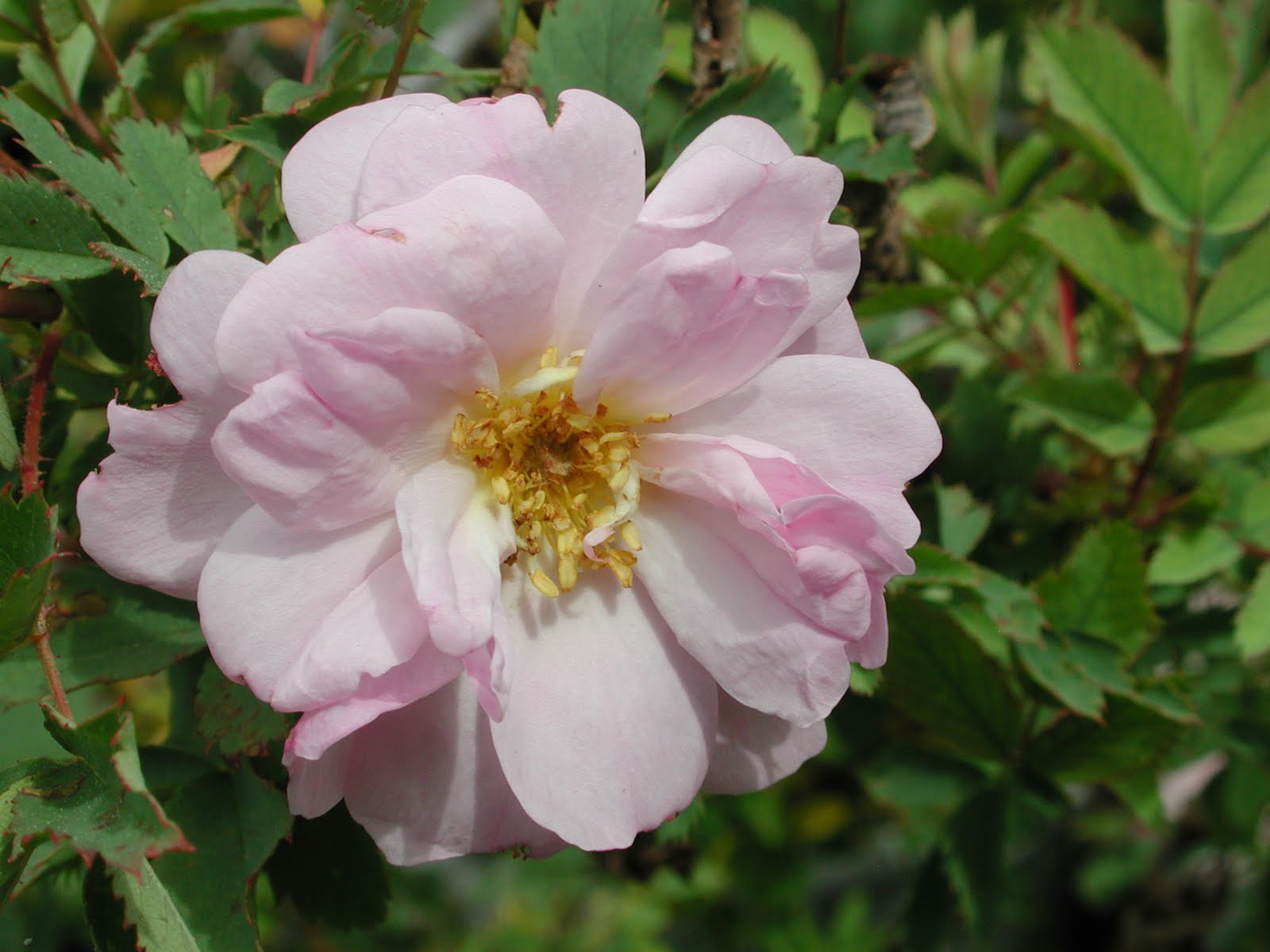
Here are some you probably haven't seen yet. This first one is a cross using Florence Bowers Pink Tea as the seed parent. Unfortunately the tag is missing so I'm not positive what the pollen parent was. I used Paul Barden's 42-03-02, Purezza and Tom Thumb extensively and this could have resulted from any of them. It has rather nice form, color and scent and the foliage appears it may be good. It's definitely from Florence Bowers Pink Tea as it was in the middle of a cluster of pots of her seedlings.
This should be quite interesting. Nessie [(R. Brunonii X R. Gigantea) X Mlle Cecile Brunner] X Tom Thumb! It should be a polyantha type plant. It has some scent and it repeats regularly.
This is from the same cross as the above, but tremendously smaller in ever detail.
Nessie X Annie Laurie McDowell created some monster climbers as well as several odd little things. This one is about four years old. It repeats and grows in a three gallon can. Not a lot of scent. Not much growth, lots of flowers and fairly decent foliage. No prickles, either.
Seedlings are flowering! More will come as they push their flowers through the weeds! Thank you for reading!
Showing posts with label Paul Barden. Show all posts
Thursday, September 12, 2019
Friday, July 22, 2011
First Results
The first offspring from my breeding with Fedtschenkoana resulted from putting its pollen on the floribunda Orangeade. I honestly didn't know what to expect from this cross. I hoped the all summer bloom would continue, but plant habit, foliage, scent and bloom color were all totally unknown.
There are two seedlings from this cross. I've combined both under the name "Oadefed" on Help Me Find. The first seedling to flower was what I call Repeat Oadefed. It began flowering the summer following germination and continued all summer. It flowers on new growth. The plant shows first generation hybrid vigor, being an even more aggressive spreader (via suckers) than Fedtschenkoana. It is a taller plant which branches, while the species seldom branches unless forced to by cutting or damaging the canes. Its flowers are all carried at the ends of canes and side branches in small clusters.
The blooms are double and open to reveal the stamen. Its petals are papery and soft, beginning a blush pink and whitening to a similar, brilliant white. They arrive in small clusters usually at the ends of the canes and any side branches. They continue the same "Linseed Oil" scent and the plant retains its scented new growth, only it has morphed into more of a cedar scent. Foliage color is different from the species, being more of a yellow-gray-green and turns yellow-gold in fall before being shed for the winter.
Repeat Oadefed will set seed, usually one or two per hip, and the hips remain the same shape and size of the species.
Once flowering Oadefed feels related to the Repeat seedling, but different in a number of ways. Instead of suckering far and wide, it's a much tighter plant, creating a much denser colony of canes. Initially, it flowered on the tops of the canes, at the leaf axis, and resembled a Hollyhock the first two years it flowered. These flowers are more double than the Repeat seedling appears and open quite a bit more formal in shape. Its buds are a deeper pink than the other seedling and remain pink when open, though it also fades from the original color.
Its foliage is a bit more blue-green than the other seedling and has a shorter autumn color period than the repeater before its leaves brown and fall. This is the seedling Paul Barden has created his amazing purple seedlings from. FedtLav-01, FedtLav-08, FedtLav-09.
Both seedlings are pollen and seed fertile and not quite as particular about accepting other pollen or working on other ovaries as Fedtschenkoana itself is.
Once flowering Oadefed hip.
Orangeade has the characteristic of intensifying all plant pigments, from foliage and wood to flower color. I'd imagined these seedlings flowering with pink petals, but felt surely they would be deeper, more saturated colors than they are. Both retain the "linseed oil" flower scent with papery petals.
I'd begun studying seedlings created with Basye's Legacy, a remarkable species hybrid created by Dr. Robert Basye, formerly of Texas A&M University. The rose had been passed from one enthusiast to the next, often called "Basye's Thornless". Dr. Basye created two thornless seedlings which he spread around. One, he called 65-626, he wished named "Commander Gillette" after his military commander. The second, 77-361, was bred from Commander Gillette. Both were generally called "Basye's Thornless", creating a great deal of confusion. I'd discovered this rose growing in the Study Plot at The Huntington Library. I'd propagated it and found in their plant card file that this rose was sent to them by Dr. Basye himself and was identified by him as 77-361. Paul Zimmerman, who owned Ashdown Roses at the time, wished to offer it through his catalog to get it wider distribution. We discussed what to call it to differentiate it from the other rose and determined Basye's Legacy was the right name to use for it as it can be extremely useful in creating thornless, black spot resistant roses.
I've grown the 77-361 (Basye's Legacy) from The Huntington, and 65-626 (Commander Gillette) shared by Dr. Basye with a gentleman I met through Garden Web years ago. I've also grown roses spread around as "Basye's Thornless" and all of them are the same rose. There are no differences among them. Which rose it is, no one is going to be able to tell until it is DNA tested. Dr. Basye personally identified the same rose as both 77-361 and 65-626.
I was extremely impressed by its ability to pass along thornless canes, a high degree of disease resistance and extreme fertility. I wanted to see what Basye's Legacy could do combined with Fedtschenkoana's genes, but remembered how obstinate Fedtschenkoana could be as a breeder.
Orangeade had been the best mate for Fedtschenkoana to that point, and I already had a seedling combining it with Legacy, so Dottie Louise was the logical choice for the next step. Dottie Louise was the childhood name for Mrs. Dorothy Crallie, owner and proprietor of the wonderful Pixie Treasures Miniature Rose Nursery, formerly located in Yorba Linda, California. With her daughter, Laurie Chaffin, who is a very talented, creative rose breeder, they produced some beautiful roses and satisfied a loyal clientele for many years. Dorothy loved single roses. This seedling was nearly single and was the first commercial offspring of Dr. Basye's wonderful thornless hybrid. I asked Dorothy's permission to name it for her, but she felt "Dorothy Crallie" wouldn't sell the rose. Laurie suggested her girlhood name, which her school friends still called her, Dottie Louise". Perfect!
Should anyone find the Oadefed seedlings of interest, the time has come to down-size my rose collection. The Once Flowering Oadefed is destined to be removed from the collection. Suckers are available to interested people here in the Continental US for the cost of postage. Please let me know if you'd like some.
Next: The Dottie Louise X R. Fedtschenkoana hybrids.
There are two seedlings from this cross. I've combined both under the name "Oadefed" on Help Me Find. The first seedling to flower was what I call Repeat Oadefed. It began flowering the summer following germination and continued all summer. It flowers on new growth. The plant shows first generation hybrid vigor, being an even more aggressive spreader (via suckers) than Fedtschenkoana. It is a taller plant which branches, while the species seldom branches unless forced to by cutting or damaging the canes. Its flowers are all carried at the ends of canes and side branches in small clusters.
The blooms are double and open to reveal the stamen. Its petals are papery and soft, beginning a blush pink and whitening to a similar, brilliant white. They arrive in small clusters usually at the ends of the canes and any side branches. They continue the same "Linseed Oil" scent and the plant retains its scented new growth, only it has morphed into more of a cedar scent. Foliage color is different from the species, being more of a yellow-gray-green and turns yellow-gold in fall before being shed for the winter.
Repeat Oadefed will set seed, usually one or two per hip, and the hips remain the same shape and size of the species.
Once flowering Oadefed feels related to the Repeat seedling, but different in a number of ways. Instead of suckering far and wide, it's a much tighter plant, creating a much denser colony of canes. Initially, it flowered on the tops of the canes, at the leaf axis, and resembled a Hollyhock the first two years it flowered. These flowers are more double than the Repeat seedling appears and open quite a bit more formal in shape. Its buds are a deeper pink than the other seedling and remain pink when open, though it also fades from the original color.
Its foliage is a bit more blue-green than the other seedling and has a shorter autumn color period than the repeater before its leaves brown and fall. This is the seedling Paul Barden has created his amazing purple seedlings from. FedtLav-01, FedtLav-08, FedtLav-09.
| Once Flowering Oadefed autumn foliage |
Both seedlings are pollen and seed fertile and not quite as particular about accepting other pollen or working on other ovaries as Fedtschenkoana itself is.
Once flowering Oadefed hip.
Orangeade has the characteristic of intensifying all plant pigments, from foliage and wood to flower color. I'd imagined these seedlings flowering with pink petals, but felt surely they would be deeper, more saturated colors than they are. Both retain the "linseed oil" flower scent with papery petals.
I'd begun studying seedlings created with Basye's Legacy, a remarkable species hybrid created by Dr. Robert Basye, formerly of Texas A&M University. The rose had been passed from one enthusiast to the next, often called "Basye's Thornless". Dr. Basye created two thornless seedlings which he spread around. One, he called 65-626, he wished named "Commander Gillette" after his military commander. The second, 77-361, was bred from Commander Gillette. Both were generally called "Basye's Thornless", creating a great deal of confusion. I'd discovered this rose growing in the Study Plot at The Huntington Library. I'd propagated it and found in their plant card file that this rose was sent to them by Dr. Basye himself and was identified by him as 77-361. Paul Zimmerman, who owned Ashdown Roses at the time, wished to offer it through his catalog to get it wider distribution. We discussed what to call it to differentiate it from the other rose and determined Basye's Legacy was the right name to use for it as it can be extremely useful in creating thornless, black spot resistant roses.
I've grown the 77-361 (Basye's Legacy) from The Huntington, and 65-626 (Commander Gillette) shared by Dr. Basye with a gentleman I met through Garden Web years ago. I've also grown roses spread around as "Basye's Thornless" and all of them are the same rose. There are no differences among them. Which rose it is, no one is going to be able to tell until it is DNA tested. Dr. Basye personally identified the same rose as both 77-361 and 65-626.
I was extremely impressed by its ability to pass along thornless canes, a high degree of disease resistance and extreme fertility. I wanted to see what Basye's Legacy could do combined with Fedtschenkoana's genes, but remembered how obstinate Fedtschenkoana could be as a breeder.
Orangeade had been the best mate for Fedtschenkoana to that point, and I already had a seedling combining it with Legacy, so Dottie Louise was the logical choice for the next step. Dottie Louise was the childhood name for Mrs. Dorothy Crallie, owner and proprietor of the wonderful Pixie Treasures Miniature Rose Nursery, formerly located in Yorba Linda, California. With her daughter, Laurie Chaffin, who is a very talented, creative rose breeder, they produced some beautiful roses and satisfied a loyal clientele for many years. Dorothy loved single roses. This seedling was nearly single and was the first commercial offspring of Dr. Basye's wonderful thornless hybrid. I asked Dorothy's permission to name it for her, but she felt "Dorothy Crallie" wouldn't sell the rose. Laurie suggested her girlhood name, which her school friends still called her, Dottie Louise". Perfect!
Should anyone find the Oadefed seedlings of interest, the time has come to down-size my rose collection. The Once Flowering Oadefed is destined to be removed from the collection. Suckers are available to interested people here in the Continental US for the cost of postage. Please let me know if you'd like some.
Next: The Dottie Louise X R. Fedtschenkoana hybrids.
Friday, July 15, 2011
1-72-1Hugonis
(Remember to click on the red links for further information about the subjects. Clicking on the photos opens larger images of them in a new window.)
I obtained a species rose from Ralph Moore a long time ago, which he identified as R. Hugonis. It has many characteristics in common with it, but some have questioned the identity. Until someone can positively identify it as something else, I am content to call it Hugonis.
I'd put its pollen on quite a few roses over the years, often with no results. One year, a seedling germinated from a batch of seed harvested from his wonderful mini breeder, 1-72-1, from pollen from this Hugonis. From the look of it, this one was definitely not a self set seed, but had to be from the species pollen. It is unnamed, other than to document its parentage, 1-72-1Hugonis.
The foliage is larger than the species, but still has much of its appearance. Two other very nice differences between it and the species are the seedling's near total lack of prickles and its greater vigor.
I had the good sense to share cuttings of it with Paul Barden, who was a great steward of it. Unfortunately, I lost the original plant, but Paul propagated it and sent me back a plant. (soap box time)...If you have a rare plant or seedling and wish to make sure you don't lose it permanently, PLEASE share it with those who will keep it going because they value it. Ralph Moore lost a number of roses over the years he lamented losing because he never shared them. This was one good reason he was as generous with his breeding stock in later years.
I've grown the plant Paul sent me in a seven gallon can for several years, finally getting it into the ground this summer. Now, it is doing something I've never witnessed from it. After the spring flush of flowers, the heat wave has brought another flush of bud and bloom! These images were taken yesterday morning, July 14, 2011, weeks after the spring flush of bloom was complete. There are other buds forming on the plant.
I'll be watching this one closely from now on in hopes of it stabilizing and providing reliable repeat flowering. I'm also keeping my fingers crossed as I beat the rodents to the ripe hips this year! Next spring should (hopefully!) see some first generation hybrids of this lovely Hybrid "whatever it is"!
Thursday, May 5, 2011
Wrapping cuttings
If you haven't already discovered it, The Rose Hybridizers Association and its Forum are great places to learn about many things concerning roses. The site is populated by a very nice group of people from across the globe and all have great imagination and experiences. One very interesting "discovery" I've gleaned from the RHA and from Paul Barden's Rose Blog concerns wrapping cuttings to callus.
I formerly lived in a hotter, more arid climate, and I had figured out how to root roses there with little difficulty. I have since moved to a more humid, a bit less hot, area and I have sacrificed MANY cuttings to rot before hitting on this wonderful advance. The initial introduction was made by Simon Voorwinde , an Australian member sharing what George, another Australian member had shared with him. Rose Hybridizers Association Forum
Photographic instruction and mention of the method was further shared by Paul Barden on his great Rose Blog. Paul Barden's Blog It looked and sounded simple enough!
I'd discovered part of my problem was it is too humid here to enclose rose cuttings in anything. The air is sufficiently "close" for them to root without rotting as long as they are protected from extreme wind and too hot sunlight. Using this wrapping method further increased my chances of success by keeping them moist while they callus and begin forming roots, greatly shortening the time required for them to actually become plants.
I "streamlined" the proceedure shared on the other two sources and found it worked! I took cuttings as I would normally, removed all the foliage and processed them with my rooting hormone of choice. Several sheets of plain old newspaper were thoroughly soaked then wrung out as dry as I could get them. Here is your first chance of failure. There should be NO dripping wet paper. Wring out as much water as you possibly can. The cuttings are going to be securely wrapped in this paper. Soggy paper WILL cause them to grow mold and turn into slime. You want moisture, dampness, not soggy, so squeeze out as much water as you possibly can so the paper no longer drips when squeezed.
I placed the pile of cuttings all together in the center of the paper, then wrapped them as you would to make a burrito. It looks something like these, though the longer ones shown are actually longer than traditional cuttings. More about those, later.
Instead of wrapping the "burritos" in Saran Wrap and rubber banding them as Simon's method suggests, I found simply wrapping them in plastic shopping bags then tying them tightly, kept them sufficiently damp for the callusing period. As long as the bags are sealed to prevent the loss of the dampness, it will work. I placed the bags in a drawer in a chest in the garage where they remained cool and dark for the required two weeks.
At the end of the two weeks, this is what I found in the "burritos".
I removed them from the "burritos" and potted them individually in 16 oz. foam cups with drainage holes poked through the bottoms and placed them where they would receive half day, morning sun, surrounded by other plants where the humidity remains fairly high. I deliberately planted them deeply, as deep as possible in the cups, to provide them more protection from moisture loss until they rooted.
I kept them watered so the soil remained damp and within a few weeks, new sprouts were growing from most of the cuttings. I had gone from 100% failure, to over 80% success with 135 cuttings. This was with a variety of different rose types, from polyanthas, climbers, species crosses, HTs and floribundas, not just a few varieties which root fairly easily. I am certain pre callusing the cuttings in the dark, damp, cool newspaper before planting them was more than half the key. This was accomplished during our rainy period, so temperatures were lower than "normal" and there was higher humidity, so everything stacked the deck in my favor.
Next installment...Longer wrapped cuttings for standard trunks, and in warmer weather!Paul Barden's Blogspot
I formerly lived in a hotter, more arid climate, and I had figured out how to root roses there with little difficulty. I have since moved to a more humid, a bit less hot, area and I have sacrificed MANY cuttings to rot before hitting on this wonderful advance. The initial introduction was made by Simon Voorwinde , an Australian member sharing what George, another Australian member had shared with him. Rose Hybridizers Association Forum
Photographic instruction and mention of the method was further shared by Paul Barden on his great Rose Blog. Paul Barden's Blog It looked and sounded simple enough!
I'd discovered part of my problem was it is too humid here to enclose rose cuttings in anything. The air is sufficiently "close" for them to root without rotting as long as they are protected from extreme wind and too hot sunlight. Using this wrapping method further increased my chances of success by keeping them moist while they callus and begin forming roots, greatly shortening the time required for them to actually become plants.
I "streamlined" the proceedure shared on the other two sources and found it worked! I took cuttings as I would normally, removed all the foliage and processed them with my rooting hormone of choice. Several sheets of plain old newspaper were thoroughly soaked then wrung out as dry as I could get them. Here is your first chance of failure. There should be NO dripping wet paper. Wring out as much water as you possibly can. The cuttings are going to be securely wrapped in this paper. Soggy paper WILL cause them to grow mold and turn into slime. You want moisture, dampness, not soggy, so squeeze out as much water as you possibly can so the paper no longer drips when squeezed.
I placed the pile of cuttings all together in the center of the paper, then wrapped them as you would to make a burrito. It looks something like these, though the longer ones shown are actually longer than traditional cuttings. More about those, later.
Instead of wrapping the "burritos" in Saran Wrap and rubber banding them as Simon's method suggests, I found simply wrapping them in plastic shopping bags then tying them tightly, kept them sufficiently damp for the callusing period. As long as the bags are sealed to prevent the loss of the dampness, it will work. I placed the bags in a drawer in a chest in the garage where they remained cool and dark for the required two weeks.
At the end of the two weeks, this is what I found in the "burritos".
I kept them watered so the soil remained damp and within a few weeks, new sprouts were growing from most of the cuttings. I had gone from 100% failure, to over 80% success with 135 cuttings. This was with a variety of different rose types, from polyanthas, climbers, species crosses, HTs and floribundas, not just a few varieties which root fairly easily. I am certain pre callusing the cuttings in the dark, damp, cool newspaper before planting them was more than half the key. This was accomplished during our rainy period, so temperatures were lower than "normal" and there was higher humidity, so everything stacked the deck in my favor.
Next installment...Longer wrapped cuttings for standard trunks, and in warmer weather!Paul Barden's Blogspot
Subscribe to:
Posts (Atom)