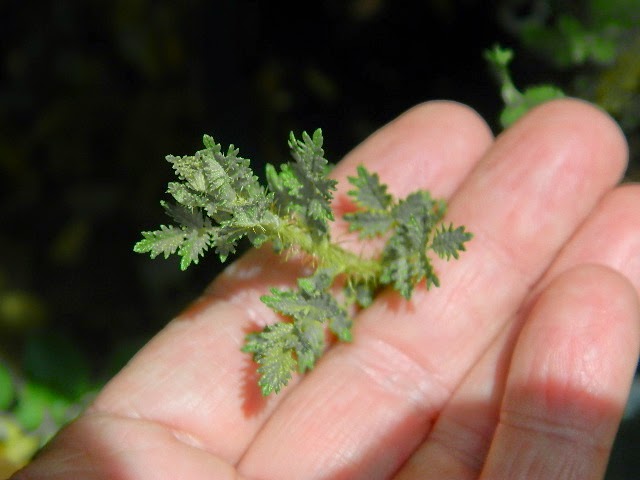
I have worked with R. Minutifolia for some years now and am finally seeing some success. Previously, the few seedlings to germinate were terribly diseased and very weak. Now, using fertile triploid roses, there are some healthy, vigorous seedlings showing some promise. I'm intrigued with the triploid crosses because they express a very wide range of each of the parents' traits and have succeeded where the diploid and tetraploid crosses didn't.
There are four seedlings from its pollen now listed on Help Me Find-Roses. I planted self seeds of one this April, just two months ago, and already have flowering seedlings from those seeds! The first rose which produced successful crosses with Minutifolia is Jim Sproul's L56-1,
a brilliant, healthy, fertile single red mini he bred from his healthy Thrive!. The chromosomes haven't been counted yet, but L56-1 certainly breeds like a triploid. Here are foliage samples from L56-1, Minutifolia (Otay Mesa version from the Otay Mesa in San Diego, CA), L56-1 X Minutifolia and a self seedling of the L56-1 X Minutifolia. I didn't record which of the original seedlings these seeds formed on.
Top left, L56-1; top center, Minutifolia; top right self seedling of L56-1 X Minutifolia; lower right, L56- X Minutifolia.
Stipules of the above. The L56-1 X Minutifolia foliage is in the center.
These are the self seedlings from which the sample above was taken. I'm amazed the seeds were only planted back in April, 2016. Today is May 30, 2016!
The second new Minutifolia seedling of 2016 is Lynnie X Minutifolia. Here are foliage samples from Lynnie, Minutifolia and Lynnie X Minutifolia.
Minutifolia and the Lynnie X Minutifolia seedling have very serrated foliage.
Lynnie's foliage is rather smooth edged.
The seedling is extremely well branched, right at ground level, something Lynnie seedlings generally don't produce. It appears to be without prickles, which is very surprising.
The sepals are quite interesting. Traditionally. Lynnie seedling sepals are very strap-like and not very lacy. These show more of the Minutifolia "branching".
This is the most spreading of the L56-1 X Minutifolia seedlings. It flowers repeatedly.
I'm eager to see what results from these and from crossing Minutifolia and Pure Bea, the white Minutifolia with larger foliage and flowers, on the L56-1 Minutifolia seedlings. There are already hips forming on one of them from those pollens. Exciting!
Showing posts with label R. Minutifolia. Show all posts
Monday, May 30, 2016
Friday, May 9, 2014
Continuing obsession...
R. Minutifolia is one of the most beautiful and interesting roses I have encountered. It's unlike any other, with its tiny foliage and how it "hop scotches" across the ground instead of suckering.
After a cane has flowered, it bends over to touch the ground, much like a peanut plant. Once the tip contacts suitable soil, it roots, "hop scotching" across the ground.
Minutifolia is completely healthy in the two areas I've grown it. Reportedly, it dislikes summer water, however I've had great success growing it in the ground as well as five gallon nursery containers in standard potting soil, providing it with the same water levels and frequencies I've provided all the other roses. This rose goes summer dormant. The tiny foliage and bristles permit it to capture moisture from the fogs. When moisture becomes truly scarce, the foliage dries up and is shed, reducing the water needs of the plant until the rains or fogs return.
There are supposedly two, distinct forms of the species. The most commonly available is the San Diego form which has been propagated from the stand naturally occurring on Otay Mesa in San Diego County. It seldom sets seeds, appearing to be self sterile and possibly female sterile as well. It has refused every pollen I have ever placed on it. The other form is from the stand naturally occurring in Mexico. The Mexican form reportedly sets seed quite well.
I've worked with R. Minutifolia for far too many years to count by now. Seeds have been generated, a few have actually germinated, yet none have survived. I've most frequently used its pollen to pollinate blooms on miniatures and the more fertile floribundas I prefer to use as seed parents. This year, I've even attempted to pollinate R. Fedtschenkoana with Minutifolia's pollen.
Working with these tiny, prickly buds can be rather "frustrating". They're difficult to hold on to because they are so small to begin with. Add the bristles on the ovaries which make them incredibly slippery and you can imagine what it's like to collect pollen from a large quantity of them. Fortunately, or unfortunately, my four plants seldom provide "large" numbers of buds at one time.
Finding these tiny buds among the minute foliage can be quite difficult.
It isn't as difficult when they appear at the terminal ends of the canes as it is when they hide among the tiny leaves along the canes.
After a cane has flowered, it bends over to touch the ground, much like a peanut plant. Once the tip contacts suitable soil, it roots, "hop scotching" across the ground.
Minutifolia is completely healthy in the two areas I've grown it. Reportedly, it dislikes summer water, however I've had great success growing it in the ground as well as five gallon nursery containers in standard potting soil, providing it with the same water levels and frequencies I've provided all the other roses. This rose goes summer dormant. The tiny foliage and bristles permit it to capture moisture from the fogs. When moisture becomes truly scarce, the foliage dries up and is shed, reducing the water needs of the plant until the rains or fogs return.
There are supposedly two, distinct forms of the species. The most commonly available is the San Diego form which has been propagated from the stand naturally occurring on Otay Mesa in San Diego County. It seldom sets seeds, appearing to be self sterile and possibly female sterile as well. It has refused every pollen I have ever placed on it. The other form is from the stand naturally occurring in Mexico. The Mexican form reportedly sets seed quite well.
I've worked with R. Minutifolia for far too many years to count by now. Seeds have been generated, a few have actually germinated, yet none have survived. I've most frequently used its pollen to pollinate blooms on miniatures and the more fertile floribundas I prefer to use as seed parents. This year, I've even attempted to pollinate R. Fedtschenkoana with Minutifolia's pollen.
Working with these tiny, prickly buds can be rather "frustrating". They're difficult to hold on to because they are so small to begin with. Add the bristles on the ovaries which make them incredibly slippery and you can imagine what it's like to collect pollen from a large quantity of them. Fortunately, or unfortunately, my four plants seldom provide "large" numbers of buds at one time.
Finding these tiny buds among the minute foliage can be quite difficult.
It isn't as difficult when they appear at the terminal ends of the canes as it is when they hide among the tiny leaves along the canes.
The batch of buds pictured above finally provided their harvest after more than half an hour of "micro surgery". After two days of air drying on a piece of paper, it was back out in the garden to spread their golden dust in this year's attempts at finally raising seedlings containing their genes. Wish me luck!
Subscribe to:
Posts (Atom)