Tuesday, August 16, 2011

Not a Rose, but what IS it?

The area I'm turning into my "rose garden", was a dichondra lawn nearly forty years ago. Since that time, it's been permitted to provide a home to whatever weeds wished to grow and which would endure regular weed whacking with no irrigation.

The roses are settling in, as are all manner of odd "volunteers". The Mesquite tree down the hill, way down the hill, is producing seedlings there. The Dodonea hedge I planted is also producing baby Hopseed Bushes.

Now, there is this...


Nothing I've planted anywhere on the hill produced this, nor anything I have dug or pulled. It kind of looks as if it should be some kind of melon or something, but those prickles! They are sharp and they are everywhere.

I kind of like odd plants. Solanum pyracanthum is quite happy here, and I find it rather interesting. At least, nothing seems to find it delicious! But, this thing...

It's pretty and those bright yellow flowers just do not fade. It seems to be setting a lot of "fruit". Might anyone have an idea just what the heck the thing is, please?

How soon till they bloom?

I've had several people ask recently how soon a new seedling can bloom. It all depends...

I have a climbing seedling from Ralph Moore's climbing yellow mini breeder, 1-72-1 crossed with the lovely dark purple shrub, Midnight Blue. It's a very nice plant: completely thornless, lovely foliage and very disease resistant. It is going into its third year since germination and it has yet to flower...once.

Then, you have this kind of thing. This is planted in a four inch pot, to give you a point of reference so you can estimate the size.


This little rose germinated February of 2011, making it about six months old. The seed parent is the russet mini, Suntan Beauty. The "father", or pollen parent, is my thornless shrub, Indian Love Call. My hope was to create a dwarf, repeat blooming, thornless, healthy shrub rose. This one should be repeat flowering by the fact that it has flowered at six months old. Once flowering roses shouldn't flower for another year, or two, from seed.

I love the sepals on the rose and the bud is quite attractive. I know it will be double and it's a very good bet that it will be pink! Not a favorite of mine, but if it's healthy, hopefully prickle free with a nice plant habit and frequently in flower, how can I reject it?

So, as you see, new baby roses CAN flower fairly early in their lives. Anyone want a thornless, healthy climbing rose that won't flower?

Tuesday, July 26, 2011

Odd rebloom...

I was excited to see the 1-72-1Hugonis seedling throwing new flowers after the main flush earlier this spring and summer. I'm even more thrilled to see it continue throwing buds and blooms now that the real heat is hitting us.


I had made the decision that reducing the number of roses to be maintained on this hill was definitely the right decision, and even determined that letting one of the original Fedtschenkoana seedlings, Once Bloom Oadefed, go was the proper thing to do.

This morning, while out checking the squirrel traps, I noticed this rose must have understood I was about to dump it. There was a spent flower and a bud about to open! The usual spring flush is well over and the weather hasn't played the usual tricks which make once flowering roses "repeat". So, what is with this one and why is it throwing more flowers?


Disbudding to push growth

As I've mentioned here and on Garden Web, some private lists and elsewhere, some roses want to flower at the expense of growth. Rosarium Uetersen is notorious for blooming like a short floribunda and not climbing. One of my favorites of my own roses does the same. Annie Laurie McDowell LOVES to flower! Small plants of her will flower like crazy and take forever to throw the climbing canes you expect from her.

Here are a few photos of an own root plant I rooted just this year. She's tried to flower several times. It broke my heart to have to pick off the buds, but by not letting her flower, you can see the basal she's pushing out of the bottom of the original cutting. You can also see the smaller side branching she's developing.


The browning on the foliage isn't disease, but due to high heat and water stress. Smaller, immature plants will mature much faster in warmer pots than they will in the ground. Warmer soil has much more active bacterial action, digesting nutrients from the more organic potting soil and increasing the cellular activity of the plant. Giving it the warmer root space, keeping it properly watered, feeding regularly and not letting it flower will push the dickens out of it, forcing it to grow and develop the plant you expect much more quickly. I think the photos above of a plant less than six months old helps to prove my point.

Saturday, July 23, 2011

China rose update...

These cuttings were unwrapped June 11 after being held for their two week callus period. I'd wrapped two different China roses and Shadow Dancer. All of the Shadow Dancer hung on until it got hot, then they collapsed. All but two of the one variety of China rose have turned black and failed. Of the remaining two, one is beginning to push a few small leaves. The other is just sitting there....

The second variety of China rose has had about a 50% success rate. These photos were shot about an hour ago.


I know part of the reason for such a failure rate is the very high heat we've experienced since the cuttings were unwrapped. I don't have a greenhouse, nor have I attempted to create anything special for them to mature in. I wanted to determine if this was a viable method of propagation for anyone to use without any special equipment. Though it appears to be one most suited for those which are easier to root, at least when the weather is hotter, I think it's shown itself to be very worthwhile. It is easy, straight forward, requires nothing special and really only requires special tweaking to make carrying them on from the unwrapping to rooted plant possible for your specific climate and situation variables.

It DOES work better when the weather is cooler, though it CAN also work when it's hotter. Definitely worth a try and some experimenting to make it fit your situation.

Friday, July 22, 2011

First Results

The first offspring from my breeding with Fedtschenkoana resulted from putting its pollen on the floribunda Orangeade. I honestly didn't know what to expect from this cross. I hoped the all summer bloom would continue, but plant habit, foliage, scent and bloom color were all totally unknown.


There are two seedlings from this cross. I've combined both under the name "Oadefed" on Help Me Find. The first seedling to flower was what I call Repeat Oadefed. It began flowering the summer following germination and continued all summer. It flowers on new growth. The plant shows first generation hybrid vigor, being an even more aggressive spreader (via suckers) than Fedtschenkoana. It is a taller plant which branches, while the species seldom branches unless forced to by cutting or damaging the canes. Its flowers are all carried at the ends of canes and side branches in small clusters.


The blooms are double and open to reveal the stamen. Its petals are papery and soft, beginning a blush pink and whitening to a similar, brilliant white. They arrive in small clusters usually at the ends of the canes and any side branches. They continue the same "Linseed Oil" scent and the plant retains its scented new growth, only it has morphed into more of a cedar scent. Foliage color is different from the species, being more of a yellow-gray-green and turns yellow-gold in fall before being shed for the winter.


Repeat Oadefed will set seed, usually one or two per hip, and the hips remain the same shape and size of the species.


Once flowering Oadefed feels related to the Repeat seedling, but different in a number of ways. Instead of suckering far and wide, it's a much tighter plant, creating a much denser colony of canes. Initially, it flowered on the tops of the canes, at the leaf axis, and resembled a Hollyhock the first two years it flowered. These flowers are more double than the Repeat seedling appears and open quite a bit more formal in shape. Its buds are a deeper pink than the other seedling and remain pink when open, though it also fades from the original color.


Its foliage is a bit more blue-green than the other seedling and has a shorter autumn color period than the repeater before its leaves brown and fall. This is the seedling Paul Barden has created his amazing purple seedlings from. FedtLav-01, FedtLav-08, FedtLav-09.

Once Flowering Oadefed autumn foliage


Both seedlings are pollen and seed fertile and not quite as particular about accepting other pollen or working on other ovaries as Fedtschenkoana itself is.

Once flowering Oadefed hip.


Orangeade has the characteristic of intensifying all plant pigments, from foliage and wood to flower color. I'd imagined these seedlings flowering with pink petals, but felt surely they would be deeper, more saturated colors than they are. Both retain the "linseed oil" flower scent with papery petals.

I'd begun studying seedlings created with Basye's Legacy, a remarkable species hybrid created by Dr. Robert Basye, formerly of Texas A&M University. The rose had been passed from one enthusiast to the next, often called "Basye's Thornless". Dr. Basye created two thornless seedlings which he spread around. One, he called 65-626,  he wished named "Commander Gillette" after his military commander. The second, 77-361, was bred from Commander Gillette. Both were generally called "Basye's Thornless", creating a great deal of confusion. I'd discovered this rose growing in the Study Plot at The Huntington Library. I'd propagated it and found in their plant card file that this rose was sent to them by Dr. Basye himself and was identified by him as 77-361. Paul Zimmerman, who owned Ashdown Roses at the time, wished to offer it through his catalog to get it wider distribution. We discussed what to call it to differentiate it from the other rose and determined Basye's Legacy was the right name to use for it as it can be extremely useful in creating thornless, black spot resistant roses.

I've grown the 77-361 (Basye's Legacy) from The Huntington, and 65-626 (Commander Gillette) shared by Dr. Basye with a gentleman I met through Garden Web years ago. I've also grown roses spread around as "Basye's Thornless" and all of them are the same rose. There are no differences among them. Which rose it is, no one is going to be able to tell until it is DNA tested. Dr. Basye personally identified the same rose as both 77-361 and 65-626.

I was extremely impressed by its ability to pass along thornless canes, a high degree of disease resistance and extreme fertility. I wanted to see what Basye's Legacy could do combined with Fedtschenkoana's genes, but remembered how obstinate Fedtschenkoana could be as a breeder.

Orangeade had been the best mate for Fedtschenkoana to that point, and I already had a seedling combining it with Legacy, so Dottie Louise was the logical choice for the next step. Dottie Louise was the childhood name for Mrs. Dorothy Crallie, owner and proprietor of the wonderful Pixie Treasures Miniature Rose Nursery, formerly located in Yorba Linda, California. With her daughter, Laurie Chaffin, who is a very talented, creative rose breeder, they produced some beautiful roses and satisfied a loyal clientele for many years. Dorothy loved single roses. This seedling was nearly single and was the first commercial offspring of Dr. Basye's wonderful thornless hybrid. I asked Dorothy's permission to name it for her, but she felt "Dorothy Crallie" wouldn't sell the rose. Laurie suggested her girlhood name, which her school friends still called her, Dottie Louise". Perfect!

Should anyone find the Oadefed seedlings of interest, the time has come to down-size my rose collection. The Once Flowering Oadefed is destined to be removed from the collection. Suckers are available to interested people here in the Continental US for the cost of postage. Please let me know if you'd like some.

Next: The Dottie Louise X R. Fedtschenkoana hybrids.

Thursday, July 21, 2011

Looking for Louis Lens' Pink Mystery

Quite a few years ago, I had the pleasure of sending many rose to Louis Lens, the remarkable Belgian rose breeder. Sharon VanEnoo, a great friend whom I met at The Huntington years ago when we were both volunteers there, traveled to Belgium frequently as her son and his family lived there. She graciously hand carried garbage bags of individually prepared bags of various roses several times over the years she visited. She met Mr. Lens and they became fast friends. Mr. Lens named two roses in her honor, Sharon's Love, and Twins, in honor of her twin grandchildren.

As a "thank you" for the material I sent him, he had Rudy Velle and Ann Velle Boudolf who bought his nursery when he retired from that area of the business, send me a large package of his wonderful roses. Pink Mystery was one of the most exciting.

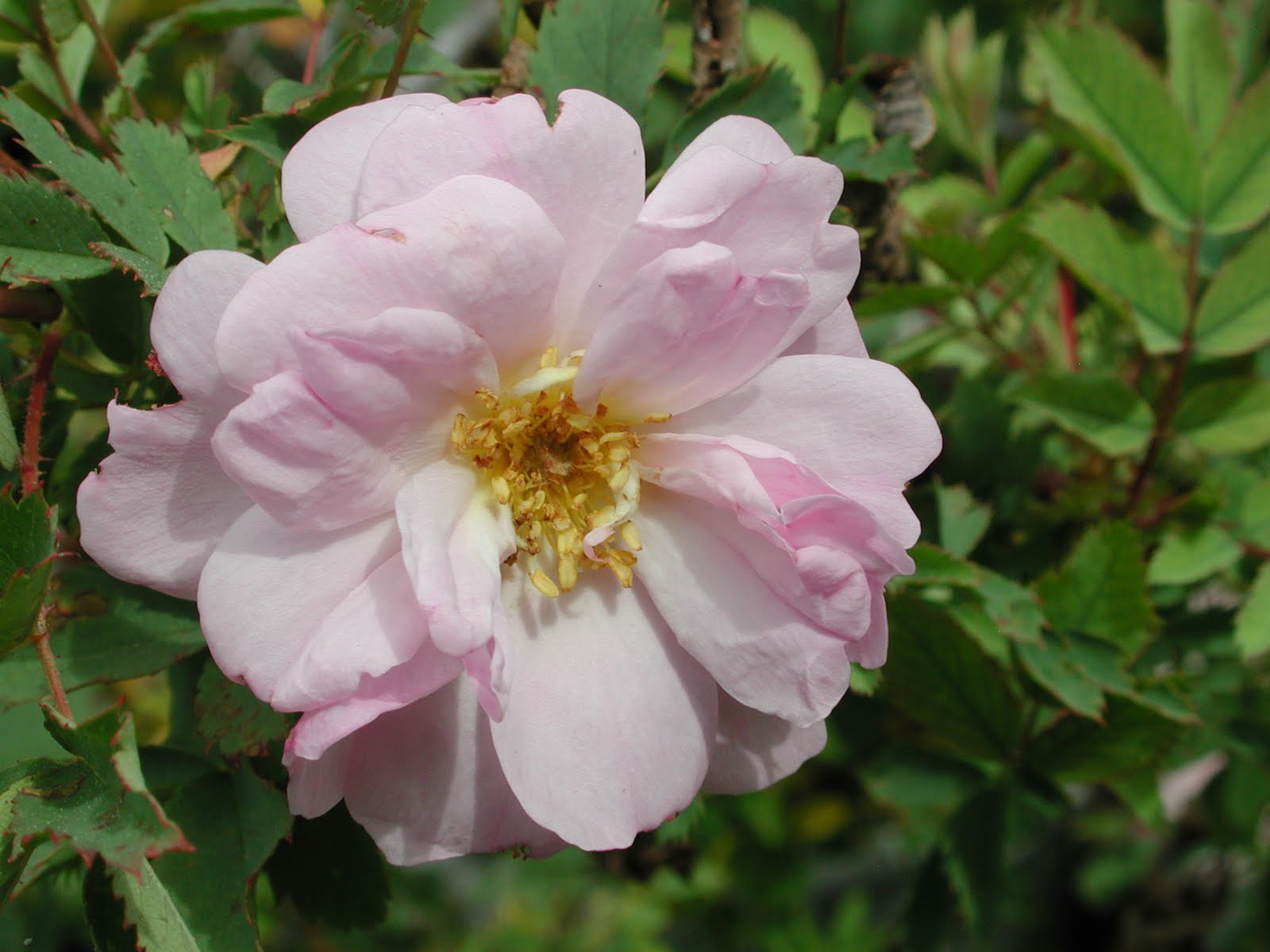
Mr. Lens was well known for his ground breaking work with species roses. He shared my fascination with the little known American species R. Stellata mirifica, the Sacramento Rose. Of the seven unique hybrids listed on Help Me Find-Roses, six belong to Mr. Lens. Unfortunately, my only photographs of Pink Mystery are unavailable. The closest I can illustrate it is by posting photos of Stellata mifirica and pointing out how it differs; providing the link to the Help Me Find-Roses page for Pink Mystery (the red "Pink Mystery" above); and by linking to photographs in Roseraie environnementale de Chaumont-Gistoux in Belgium.


Pink Mystery's flowers are actually a bit larger with wider petals than Stellata mirifica. The foliage is denser, larger, heavier and a darker green, much more "elegant" as if created from "better cloth", though knowing one will make the other immediately recognizable. Both will flower all summer if given adequate moisture and both have been totally disease free in my old mid desert garden.

Marvelous photos of Pink Mystery growing at the above mentioned garden are Photo of plant; Blooms and foliage; Flower detail. I find it very attractive how the bush in full flower resembles an annual Cosmos.

 Stellata mirifica sets very odd hips, while I never observed any on Pink Mystery.


I grew it for years in my Newhall garden and spread it around as far as I could find people willing to take it on for their gardens. Unfortunately, I lost it and it appears, so have the others who grew it as it isn't shown as being available anywhere in this country. None of the nurseries who had it, still list it. It is conspicuous in its absence on  the Lens Nursery rose list. Requests for any information concerning where it might be found on Help Me Find-Roses and Garden Web have, to date, resulted in no responses.

Hans at  Bierkreek Nursery in The Netherlands, has been searching for Pink Mystery for the past several years, with little luck. Through the generous efforts of a Help Me Find-Roses member who also lives in The Netherlands, Pink Mystery has been located in a public garden, and efforts are under way to obtain propagating material for it. Marvelous news, but difficult for us here in the United States due to the time, quarantine period and costs involved in importing rose material from there to here.

Which brings me to the point of this post. I'm hoping that someone may know of Pink Mystery's existence somewhere here in the United States or Canada. If it can be located in a garden here, cuttings or suckers could be obtained and the plant once again introduced into commerce here without the required paperwork, time and expense of importing it from overseas.