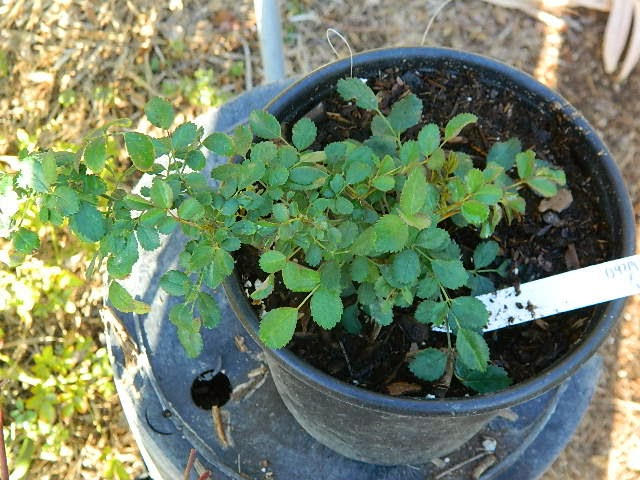
It frequently takes a season or two (or more) for seedlings to begin showing their potential. These are all plants which were bred in 2012 and germinated over winter 2012 - 2013. They've been individually potted for only about 90 days. Some of them are beginning to show some rather startling vigor.
One of the more satisfying crosses has been Pretty Lady X Lynnie. Most seedlings have quite clean, attractive foliage. Some are very low prickle count while a few have a rather high density of them. And, most are showing quite good vigor. Colors have ranged from a medium, almost lilac-pink, through the expected pink range to a light-medium red. Forms have ranged from high-centered HT; semi-double, ruffled, open to an almost quartered. A few have rather exaggerated, lacy, decorative sepals, something I am increasingly desiring in crosses. Surprisingly, there is also a good deal of scent.
Pretty Lady X Maytime. I hope it inherits Maytime's legendary mildew resistance.
April Mooncrest has proven to be a good pollen and seed parent. It is passing on decent health, vigor, scent, foliage and even some of its crested sepals.
Some rather interesting foliage colors have also shown up in this seedling batch. April Mooncrest when crossed with Pookah provided pretty summer foliage, but when things turned cool...WOW! Now temps are warming, the red tints are remaining, though slowly returning to more green.
Rosy Purple X Lynnie provided this result.
Art Nouveau has really proven to be quite a breeder! It is fertile as both seed and pollen and it germinates extremely easily. Its foliage is healthy here and so are all of its offspring so far.
Art Nouveau X Blue for You
Art Nouveau X Gina's Rose
Eyes for You didn't produce many seedlings, but this one from Eyes for You X Lynnie is quite attractive.
Yellow Sally is my seedling raised from Sally Holmes. I raised an incredibly vigorous seedling from this using pollen from Secret Garden, a found Musk rose. This one is gorgeous and more than a bit scary!
Finally, there are also some rather interesting results from my 1-72-1Hugonis seedling. Using it with a very healthy, dark red, single rose related to his Thrive!, Home Run and Knock Out, shared with my by Jim Sproul, some quite nice foliage has resulted.
Pink Petticoat X 1-72-1Hugonis provided two seedlings. One is more dwarf and diminutive.
The other is extremely vigorous with quite dense, beautiful foliage.
1-72-1Hugonis X First Impression
And, one of the most "out there" crosses to have germinated from this line yet, 0-47-19DLFED X 1-72-1Hugonis. This represents the combination of Floradora, R. Wichurana, R. Fedtschenkoana, R. Hugonis and 1-72-1. It contains three species, a mid century German floribunda, and two of Ralph Moore's most useful breeding roses. There is no way to second guess what might result from this cross.
Stay tuned as there are many more results developing from the 2012 breeding season!
I don't usually hold on to seeds planted longer than their originally expected germination period. Here, I find what I want to raise germinates within a few months (at most) from sewing, so there really isn't the need, much less room, to hold an "empty" table until the next season.
Last year, I was given seed from R. Xanthina. I planted half last year, hoping for something to result from them. Only one seedling came up and I'm honestly not convinced it is from those seeds. Fortunately, I know what was planted in the row beside the Xanthina. I use the soil in the seed tables to pot the seedlings in as I remove them to make room for the next round of new seeds. I noticed in the pots containing the seedlings from what was raised beside where the Xanthina seed were planted, some odd appearing little roses are germinating. These have been under soil now for 15 months.
I'm glad I deliberately planted the Xanthina seed next to something which appears completely different! I'm excited to see these beginning to show up. I'd looked for R. Hugonis "flore pleno" or Double Hugonis as well as the double form of Xanthina pretty much in vain. Each source listed on Help Me Find - Roses responded theirs had only five or six petals, or they had simply lost the variety entirely.
Per the 1919 American Rose Society annual, Frank Meyer, the same Frank Meyer responsible for discovering and bring to the United States the Meyer Lemon, brought Xanthina seed from China and raised seedlings in 1906. He found some of them varied quite a bit in petal count; some were true singles with only five petals,while others had up to several rows of petals. For whatever reason, the more double forms of Xanthina appear to have fallen out of commerce here. Hopefully, one or more of these Xanthina seed will provide flowers with multiple petals!
Some years ago, I raised a cross of Ralph Moore's climbing yellow miniature breeder, 1-72-1, crossed with what he gave me as R. Hugonis. The seedling has been code named, 1-72-1Hugonis so I can keep track of it. I've used it as both seed and pollen parent with some very interesting results. Seedlings from the use of its pollen on other more modern roses appear to germinate easily in the expected few months from planting. Seeds from this plant, whether they were apparently self-set or from my deliberate attempts to pollinate it with other roses, germinated sparsely. As I did with the spoil containing the Xanthina seeds, I know where the soil containing the 1-72-1Hugonis seeds was used. I am also seeing these seed now germinating after 15 months in soil. In some cases, the original seedling from last year failed, but others of its siblings are coming up to fill the pots.


My suggestion is, if you intend to raise seedlings from species, plan on needing to retain the soil and containers you initially plant them in for at least a full year after planting. Not all species have expressed this delayed germination, Fedtschenkoana for one, but these from the Yellow Chinese Species definitely are. You may need to reserve those containers much longer than you may have originally intended to obtain the results you desired.