Monday, April 13, 2015

"Hybrid Musks, Climbing Polyanthas and Polyanthas"

There is much confusion over what differentiates Hybrid Musk roses, climbing polyanthas, and polyanthas. The confusion stems from the fact that all three classifications are mostly hybrids of the same species.

Hybrid Musks:

As is often the case, first we have to unlearn. Hybrid Musk’ roses actually have no proven connection with ‘R. Moschata,’ the “Musk Rose”. The Hybrid Musk class is based upon the Hybrid Multiflora, ‘Aglaia,’which resulted from a cross of R. Multiflora with ‘Reve d’Or.’ The latter has been classed as a Noisette since its introduction in 1869. All that is known of its origin for certain is it is a seedling of ‘Mme. Schultz,’ which was presumed to be a Noisette, though nothing is known for sure of her origin. As early as 1857, in The ScottishGardener; a magazine of horticulture and floriculture, ‘Mme. Schultz’ was described as being “in the way of Lamarque”, meaning she resembled what had become accepted as Noisettes, a cross between Moschata and China Roses. If we presume ‘Mme. Schultz’ was half Moschata (Musk), then ‘Reve d’Or’ was at most half Musk.’ Aglaia’ would then be one-quarter (at most) Musk and one half Multiflora, and has always been classed as a Hybrid Multiflora. Hybrid Musk roses, then, are primarily Hybrid Multifloras. They could be viewed in terms of being smaller, repeat flowering Multiflora Ramblers.

Climbing Polyanthas:

R. Multiflora is basically a climbing plant. From observation of the many self-seedlings and known hybrids, it carries dwarf, repeat flowering genes which can be expressed when the right combinations are made. “The Fairy Roses”, “Baby Roses” or R. Multiflora perpetual nana, which have long been sold as seed, are examples of dwarf, repeat flowering seedlings from it, and are classed as Hybrid Multiflora. Though they often resemble “The Gift”, which is classed as a Polyantha, they remain Hybrid Multiflora.

Polyanthas:

Mignonette’ and ‘Pacquerette’ are generally considered the first of the new breed of roses called Polyanthas. They resulted from crosses between R. Multiflora and China Roses. These roses created quite a sensation when first introduced. Quickly, many breeders were raising self-seedlings from them or crossing them with Teas, Hybrid Perpetuals, other Multiflora ramblers and Hybrid Multifloras to raise new additions to the polyantha class.

The German hybridizer, Peter Lambert crossed ‘Aglaia’ (Hybrid Multiflora) with the Hybrid Perpetual, ‘Mrs. R. G. Sharman-Crawford’ to create ‘Trier’ (Hybrid Multiflora). Suddenly, crosses of the Hybrid Multiflora “Trier” with Hybrid Teas, Hybrid Perpetuals, Teas and Floribundas, began creating Hybrid Musk roses. But, remember, ‘Trier’ is presumed to be, at most, one-eighth Musk, and known to be one-quarter Multiflora.

Most Hybrid Musks of known parentage arose from either crosses with Trier or direct crosses with R. Multiflora through ‘Ballerina’, which is virtually pure Multiflora. Peter Lambert’s Hybrid Multiflora, ‘Trier,’ was quite busy at the same time. Not only Lambert, but many others were busily crossing Trier with all manner of roses from R. Foetida, Teas, Hybrid Perpetuals to other Polyantha seedlings raising more polyanthas and a new class of roses named "Lambertianas," to honor Lambert and to describe roses that seemed to have something in common. These Lambertiana roses were basically more vigorous semi-climbing to climbing polyanthas. Shorter growing than the traditional Hybrid Multiflora rambler, and with repeat flowering, these roses were the bridge between the Hybrid Multiflora and Polyantha classes. In many ways, they could be considered Climbing Polyanthas. 

Polyanthas continued being developed toward bushier, more densely flowering plants with increasingly larger individual flowers. Crosses with Teas, Hybrid Perpetuals and Hybrid Teas reduced the cluster sizes, but increased the size of the flowers until the introduction of the Hybrid Polyantha class, later called Floribundas. As the class developed, cluster size reduced and individual flower size increased similarly to the development in the Polyantha class. Often, the same roses were crossed with the Multiflora hybrids to create both types.

Lambertianas were less vigorous “Hybrid Musks” with generally smaller flowers, but still semi-climbing to climbing habit and repeat flowering. Polyanthas are dwarf, repeat to continuous flowering hybrids of the same roses which created Hybrid Musks and “Lambertianas”. 

As was previously mentioned, R. Multiflora is a climbing type plant. Like most roses, it can mutate or sport, often to climbing forms. Climbing sports of Polyanthas often resemble repeat flowering Multiflora Ramblers, Lambertianas, even Hybrid Musks, as well they should. They all contain strong Multiflora influences, massaged by China, Tea, Hybrid Perpetual and Hybrid Tea genes. For all intents and purposes, they’re all Hybrid Multifloras. Attempts to “classify” them have predominantly been based on, “if it quacks like a duck…” Even though they all are strongly genetically related, if one “looks” as if we expect a polyantha to appear, we consider it a polyantha. The same holds true for the other two “types”, even though they are all Multiflora hybrids.

Sunday, March 29, 2015

Seedling tables

In an earlier post, I showed how to collect pollen and use it to fertilize blooms to produce seeds of your own crosses. After approximately 110 or so days after pollination, they should be sufficiently ripe for either storing until the weather is appropriate for planting, or sowing directly into soil if the temperatures are right. 

It's an easy task to harvest and store seeds. Open the ripe hip with whatever works best for you, scissors, a small knife, whatever you want to use. Remove the seeds and rub the fibers and any hip tissue from them, then place in small plastic bags with the label recording the cross, and store it in the refrigerator until ready to plant. 


Once you are ready to plant rose seeds, you'll need something to plant them in. Of course, you can use pretty much anything you have handy and want to use, but if you have many seeds to find soil for and experience some more extreme heat and aridity issues, something along these lines may be just "what the doctor ordered". 

I wanted something I could protect against slugs, snails, rabbits, rodents, squirrels and the birds who love to dig up seeds and unearth seedlings. I also wanted a method of permitting them to grow outdoors in full sun without having to worry they would dry out and fry quickly. Because I have to allow them to continue growing in the seed tables all summer until the weather is appropriate for me to transplant them individually, and clean out the tables for the next crop of seeds, I wanted something with sufficient soil to hold enough water for many vigorous seedlings at one time, particularly over the hotter, drier months. 

I also wanted something readily available and at "friendly cost". Browsing my local "home improvement store" yielded the idea of using fir fencing boards. They're 8" wide and available in 6' and 8' lengths. I could also find very green, wet boards, making them easier to keep watered as the wetter wood seems to draw less water from the soil due to evaporation. Fortunately, the store will cut the lumber for you, so I didn't even have to break out the table saw to put them together. I decided on the 6' boards. For fencing use, they have sculpted tops, which I have cut off to square the board. Then, I have them cut two boards into four foot lengths, leaving the remaining lengths (not quite two feet long) for the shorter sides of the boxes. At the local prices, each box cost about $7. 

To prevent the soil from washing through the bottoms, I selected nylon window screen, which is easily cut with ordinary scissors. To support the window screen, I used plastic hardware cloth, which is also easily cut with scissors. Staple the screen across the table form bottoms and trim the excess, then staple the plastic hardware cloth to them and remove the excess. Because the short sides aren't quite 2' long, for support under the hardware cloth, I bought an inexpensive package of  2' wooden stakes used to mark property lines, sprinkler lines, etc., and screwed them to the bottom of the table forms. 

The tables are set on saw horses with 4' lengths of  2" X 4" placed between them. The boxes are then placed on the 2" X 4" supports where the cross pieces made by the wooden stakes space the screen bottoms off the cross supports so they don't remain constantly wet, making them last longer. 

Earlier versions were all too short, requiring me to lean over to plant and remove seedlings from the tables. These new tables were placed on taller saw horses, and, with the extra height provided by the cross supports, I can stand erect and work the tables so there won't be the usual back aches due to their previously too-short height. 


You may use any type of potting soil you wish. In my conditions, I've had great success with moisture control types. This size box holds nearly four cubic feet of soil, depending upon how deeply you fill them. I only left a few inches inside the box for the seedlings to grow under screen cover because once they are a few inches tall, most birds are going to leave them alone. 

I found an inexpensive, useful method of separating the rows of seeds. Thin bamboo plant stakes are easily cut with pruning shears, or bundles of them can be cut to fit the tables using a saw. 

Now, it's easy to set the seeds in fairly straight rows, placing the plant labels at the beginning of each row so you can easily tell which seedlings belong to which cross. Once they are all set in place, cover with approximately a quarter inch of your potting medium and water in thoroughly. 


With any luck, within a few weeks, you should see some new roses poking through the soil surface. The fun begins!

Friday, December 19, 2014

Budding Over Buds

I have been asked whether it's possible to insert a bud where the stock naturally grew one. Yes, it's possible, and it can work, but here is the potential issue...

I deliberately inserted this bud of the proposed "Real Bloomfield Abundance" over where I (hopefully!) thoroughly removed the buds from the piece of Pink Clouds. All of the Bloomfield Abundance buds have definitely taken, but this new shoot may actually be one of the Pink Clouds guard buds remaining in the stock after I attempted removing them. Had this been above or below the Bloomfield Abundance bud, I would know it was definitely a "sucker" from the Pink Clouds. 

All six of the Bloomfield Abundance buds are green and swelling, almost two months after being inserted into the stock. 
 But, because I inserted this one over where a stock bud grew, I'll just have to wait until it grows and possibly flowers before I will know for sure what this growth is. Having only seen what the proposed Real Bloomfield Abundance's foliage looks like on the cuttings these buds grew on, and not really remembering much about them due to the urgency I felt to get them budded, I can't tell yet which this is. 
If it is Pink Clouds, I have budded this one in a manner permitting a suckering issue which may cause the desired rose to fail. So, while, yes it IS possible to bud where the stock grew a bud, as I suspected, it probably isn't something you really WANT to do. 

Friday, November 28, 2014

Chip Budding

Chip budding is basically slicing upward through the bark to reveal the cambium, then sliding the bud up into the slice. As with T budding, the bud should be the same size or narrower, from a thinner gauge bud stick than the stock. You can easily bud something from a quarter inch thick bud stick to an inch thick stock, but not vice versa.
 
As with any budding or grafting, you need good cambium to cambium contact. As you know, cambium is the juicy green layer just beneath the bark or skin. It's the circulatory system of the plant. It's basically stem cells. It becomes whatever is needed depending upon what conditions it encounters. It's what calluses to become roots when provided darkness and dampness, as with wrapping cuttings. It becomes scar tissue to heal wounds if left exposed to air. When in contact with other cambium, it knits the two pieces together, forming new capillary action between them so the two pieces become one. If you push the prickles off a fresh flower stem and then observe the juicy, brighter green tissue exposed where the prickles were, that's cambium.
 
You want to make sure the buds have cambium and not pith behind them. A bit is acceptable and will work, but the more cambium tissue remaining on the bud, the faster and stronger the knit will be. Cambium won't grow to pith and vice versa, so the more wood behind the bud, the greater the chances of failure or of future breakage if the cane suffers trauma or wind stress.
 
If you practice slicing buds from canes you don't care about, you will quickly learn to see whether there is too much pith or not and how to more consistently remove the buds with the correct tissue behind them. The smaller bud has cambium; the larger has less cambium and more pith. Had I made the cut shallower for the larger bud, there would have been less pith and more cambium exposed.

If the brighter green rings around the perimeter of the shield make decent contact with the cambium of the stock, this bud may work, but the smaller one above has cambium across its interior surface, so its chances and speed will be greatly increased over the larger one.
 
An interesting side line..I've found it is possible to cleave the bud in half top to bottom, resulting in the bud knitting to the stock and growing, as well as the remaining tissue in the original plant growing a new cane. Of course this requires you to harvest the bud from a cane remaining on the original plant. I've done it so I didn't have to remove much wood from a smaller, struggling plant. It's almost like splitting a liver to transplant half of it to another person.
 
Once you've removed the bud or buds you wish to insert into the stock, you need to keep them moist until they are inserted. Mel Hulse, who used to be the volunteer coordinator for The San Jose Heritage Rose Garden, kept the bud on his tongue until he finished the slice to insert it into. I use either a shallow glass of water in which I put the bud stick to prevent it from drying, or a shallow jar lid with water in it. If you drop the bud into a glass or cup of water, you have to dig it out of deeper water which can be frustrating. If it's in a shallow lid or small pan of water, it's easier to remove from the water to insert into the stock. Both bud and scion can be thoroughly wet. It isn't so much water getting in to the slice in the stock as it is dirt and fungal or bacterial contamination from the soil that can cause failure.
 
You may either make the cut in the stock first then harvest the bud or buds, or vice versa. As long as the buds are kept moist, you can wait hours to insert them.
 
Ideally, you want to de bud your stocks before you root them. It's easier, faster and you'll be less likely to damage the inserted bud removing the buds from the stock. It may surprise you to discover how deeply you need to slice into the stock to remove not only all of the primary bud tissue, but also the guard buds (one on each side of the primary bud) so they don't later become suckers.
 
Making the cut. It may be easier to look at the photos than for me to explain them. Notice the brighter green, juicier rings around the perimeter of the cuts. That is what you want to see on the reverse of the buds and (ideally) across the surface of the cut. If you don't, then you want to match the cambium on the bud reverse to the ring of cambium around your cut edges. All it takes is one contact point for it to knit together and grow. The more contact, the faster it puts out growth and the stronger the joint, but like Brylcreem, "a little dab will do you."


Then, tie it in securely. I like the Parafilm products. You can find the Parafilm 1/2" wide budding tape very inexpensively on Ebay. They stretch, increasing the pressure holding the two plant pieces together. That reduces "bleeding" from the wound and allows for a stronger bond. Parafilm also adheres to itself so it doesn't have to be tied to remain where you wrapped it. I often even wrap across the bud itself, burying it under layers of Parafilm. The film deteriorates in the heat, water and Ultra Violet and will begin splitting as the plant thickens. Buds can actually grow through it so you don't have to remove it as the bud grows. Wrapping across the bud also helps prevent it from drying out until it knits to the stock, drawing moisture and nutrients from the stock.
 
You can see the film splitting in this shot.
When the stocks are vigorously growing, buds should knit to the stocks in roughly three to four weeks. The less actively they're growing, the longer it takes to knit together and increasing the chances of failure. Often, as long as more mature buds are used and the stocks are growing very vigorously, they will begin pushing new growh at three to four weeks after insertion. You can actually use fairly mature buds as long as they haven't literally begun unfurling leaves. The flatter the bud, the longer it will require to mature and begin growth.
 
After three to four weeks, as long as the buds are still green, they should have taken. You may choose to leave them alone until the following spring/summer if you're concerned they will be too soft to withstand the extremes your winter may give them if it's later in the year. You may do the traditional breaking the tops just above the bud so it remains attached, supposedly continuing to feed the stock and bud until the bud begins growth. Or, you may elect to sever the stock above the bud at the three to four week mark. The main issue I encountered was extreme bleeding from the cuts. I looked for the pruning stick I used to see in the nurseries, but could find none. I didn't want the spray asphalt as it would make a huge mess. I tried tying the Parafilm over the top like a bandage and it worked for a few of the weaker bleeders. I also tried Elmer's Glue, which must be applied either after the sun begins setting or before the sun hits the stocks, as when the sun isn't shining on them, they stop bleeding. Once the sun shines on the stocks, they bleed like mad. What finally worked best was dripping candle wax on the wounds before the sun shined on them so the dried wax would seal the capillaries. Some required several applications to finally fully seal the wounds. Don't worry if you drip wax on the buds. It isn't hot enough, nor enough of a "seal" to harm them. Once I stopped the sap loss, the increased pressure in the stocks began pushing buds like nobody's business!
 
If you have many of the same bud and want to conserve stocks, and if you've rooted longer pieces, you may insert many buds in each stock. You may also root a long whip of a rambler or climber and bud along the more horizontal surface of the longer whip. That will actually push growth faster for the same reason training climbing canes to a more horizontal direction will push lateral growth along the cane. The multiple buds growing on the same stock can be used to provide extra cuttings for own root propagation, or, if you allow enough room between them, once they have knit and begun growing, their first winter they may be separated and wrapped or otherwise treated as individual cuttings, producing individually budded, rooted plants.
 
 If you have a mist system set up, you can bud to unrooted stocks, then root them while the buds knit. Sequoia did that for mini standards all the time.
 
The first cane to grow from the inserted bud is the "maiden". When you read older rose books and they talk about the finest exhibition blooms are from "maidens", this is what they mean. I let them grow out and flower so they are mature when I cut them and so their foliage begins feeding the stock. You have to cut the maiden back pretty far, close to the stock, but leaving a bit of tissue there to potentially provide a few buds from that main cane. Cutting it back close to the stock encourages the guard buds to break into growth, producing the multi branched growth you look for when selecting a bare root. The "one cane wonder" bare roots are usually un cut maidens. Mistakenly, we tend to leave that original main cane so all future growth comes from it, when we SHOULD cut it back to an inch or so to encourage side branching from the guard buds.
 
See the main bud in the center and the two guard buds, one on either side? 

That's what you want to cut sufficiently deep to remove when you de bud the stocks to prevent suckers. There is enough growth material from all three buds remaining in this stock to produce suckers from all three. Plus, I removed enough material of all three to produce new growth once inserted into a stock. That goes back to splitting a liver above. And, this illustrates why simply cutting a sucker off results in the growth of two or more from that cut, and why they have to be ripped or dug from the stock.
 
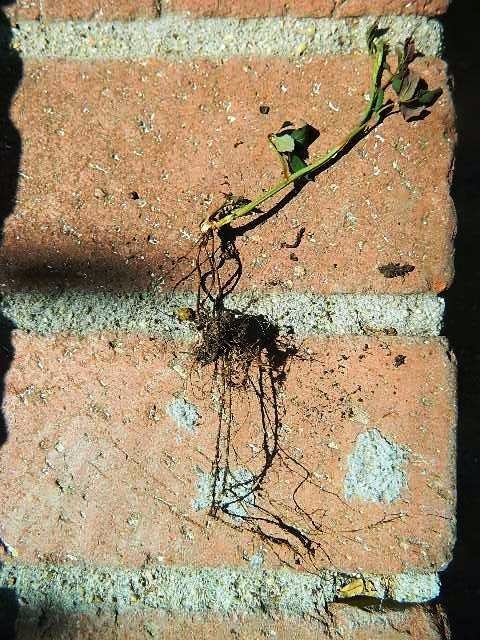
This is one I left too long and it actually set out its own roots. 


You actually don't HAVE to leave the top flap on the cuts to insert the top of the shield under. It makes it easier, but it isn't absolutely necessary. If both the stock and shield (scion) have droplets of water on them, the water will act like glue, causing them to adhere to one another until you tie them in. 

Don't worry if your results look inelegant. With practice, your 'elegance' ability will significantly improve and it doesn't seem to make a bit of difference to the plants. I have quite a few where there is a lot of scar tissue, thickened cambium, between the bud and stock and they're growing and flowering just fine. Some are going to make Grade 1 budded plants fast. Others will make Grade 2 or 1.5 and take their time. Some of that depends upon the variety, some on the size and maturity of the buds used. Prevailing weather conditions probably play a role, too.
 
The most common causes for bud failure are:
 
Insufficient cambium layer on the back of the scion/too much pith
 
Mismatched cambium between the scion and wound in the stock
 
Buds drying out prior to insertion
 
Stocks drying out prior to the buds knitting
 
As long as you've gotten the stocks growing vigorously, keep them well watered for the next month or a bit longer to keep that sap flowing freely so the buds knit and start growing ASAP. They don't require "full sun" and may even perform better in fewer hours than they normally might in your climate. In the "garden" mine would usually receive six to eight hours of sun. In the front walled garden, they receive only three to four hours of direct sun, with strong, indirect light the remainder of the day. Budding works almost flawlessly in front and fails out back.
 
If you really catch the bug for budding, you can raise your own rose seedlings, root pieces from the more vigorous types then bud to them as they would be RMV free and could provide you with a steady source of root stocks. Or, you can plant a mother plant of the type you wish to use and continue rooting pieces of it for each stock you desire. I hope you have an outlet for the extra budded plants you will probably generate. If you're already pretty tapped for room, get ready! You're very likely going to need to start some new rose friendships to take care of your "excess"!


Tuesday, November 11, 2014

Announcing the 2014 pollination results

I knew I had to control myself, or there would be FAR too many seeds to make room for, so I stopped pollinating about the first of August. I figured that way, I could make sure all the hips would ripen prior to the squirrels and rats feasting on them and it would (hopefully) limit the quantity of seeds. It almost worked...
 
It's now November 11 and all but six hips have been harvested, cleaned and stored. There are still way too many crosses and hips, but that's all part of the fun, isn't it?
 
To help in selecting potential seedlings to grow on further, I've separated them into a few categories so when they flower, I hope to be able to remember why I made the cross and use that memory in evaluating the results.
 

This is what I accomplished this summer of seemingly endless extremes in sun, heat and lack of water. Considering all the plants endured, the results are probably pretty good. 

I had the fun of using quite a few of my own roses in these crosses as well as three of Jim Sproul's and two of Robert Rippetoe's. L56-1 is a very healthy, very fertile, single, saturated red "mini" containing Jim's Thrive!. M37-1 and O117-5 are two of Jim's unreleased Hulthemia seedlings. Carlin's Rhythm X China Doll is a large flowered, single pink floribunda Robert sent me some years ago. Due to the extreme conditions this summer hit us with, both M37-1 and Carlin's Rhythm X China Doll are gone. Fortunately, they did provide some seeds, which, hopefully, will germinate. 


SEED POLLEN
CRESTED
(L56-1 X Indian Love Call) X Dawn Crest
X (First Impression X April Mooncrest)
M37-1 X Dawn Crest
(IHTXLB) X C04
X April Mooncrest
(Art Nouveau X April Mooncrest) X 4N07
X Dawn Crest
L56-1 X April Mooncrest
X Dawn Crest
First Impression X Dawn Crest
X April Mooncrest
(First Impression X April Mooncrest) X Self
X Front Page
X 4N07
X Lost Tag
X Miracle on the Hudson
X Lynnie
X Grandmother's Hat
X Blue Curiosa
X (Pretty Lady X Lynnie) 
X (Cal Poly x April Mooncrest)
X (IHTXLB X Pookah)
X Singing in the Rain
X (April Mooncrest X Joyberry)
Singing in the Rain X Dawn Crest
X (First Impression X April Mooncrest)
Art Nouveau X 4N07
X Dawn Crest
April Mooncrest  X Fire'n'Spice
(Too Cute X Verdun) X Dawn Crest
HULTHEMIAS
(First Impression X ?) X Eyes for You
Tournament of Roses X Eyes for You
Singing in the Rain X Eyes for You
Art Nouveau X Eyes for You
(L56-1 X Indian Love Call) X Eyes for You
Prairie Lass X Persian Sunset
IHTXLB X Persian Sunset
Blue for You X Persian Sunset
(First Impression X April Mooncrest) X Eyes for You
(Art Nouveau X April Mooncrest) X Eyes for You
Carlin's Rhythn X Eyes for You
First Impression X Eyes for You
X Persian Sunset
O117-5 X Grey Pearl
X Rayon Butterfed
L56-1 X Eyeconic Lemonade
X M37-1
Lynnie X Persian Sunset
Eyes for You X Singing in the Rain
X (Art Nouveau X April Mooncrest)
X (First Impression X April Mooncrest)
M37-1 X (Pretty Lady X Gina's Rose)
X Renae
X IHTXLB
X Rayon Butterfed
"SPECIES"
82-03-02 X R. Roxburghii
X R. Minutifolia
(First Impression X April Mooncrest)  X Banksiae lutescens
First Impression X 86=3
X 1-72-1Hugonis
Mrs. Charles Bell X 1-72-1Hugonis
Carlin's Rhythm X Dr. E.M. Mills
Art Nouveau X R. Minutifolia
Golden Horizon X 86-3
X R. Minutifolia
42-03-02 X Banksiae lutescens
Pretty Lady X R. Minutifolia
(L56-1 X Indian Love Call) X R. Minutifolia
X Banksiae lutescens
Ping Dong Yue Ji X Banksiae lutescens
X R. Minutifolia
Torch of Liberty  X Banksiae lutescens
(Art Nouveau X April Mooncrest) X Banksiae lutescens
X 86-3
(Art Nouveau X Blue for You) X Banksiae lutescens
Raspberry Kiss  X 1-72-1Hugonis
Pink Petticoat X (Clinophylla X Bracteata)
(L56-1 X 1-72-1Hugonis) (repeat) X Self
Tom Brown X R Minutifolia
X 1-72-1Hugonis
IHTXLB X R. Roxburghii
1-72-1Hugonix X Self
X Grandmother's Hat
X Joyberry
(DLFED 3 X Midnight Blue) X Self
? X 1-72-1Hugonis
Maytime X Banksiae lutescens
Blue for You X Banksiae lutescens
X R. Minutifolia
X 86-3
X 1-72-1Hugonis
Lynnie X R. Roxburghii
X 86-3
X (L56-1 X 1-72-1Hugonis)
X R. Minutifolia
X 1-72-1Hugonis
L56-1 X 1-72-1Hugonis
X 86-3
X Banksiae lutescens
X (Clinophylla X Bracteata)
X Puzzlement
X R. Minutifolia
Banksiae lutescens X (Art Nouveau X April Mooncrest)
X First Impression
X 1-72-1Hugonis
X Blue for You
X Lynnie
M37-1 X 1-72-1Hugonis
X 86-3
X (Clinophylla X Bracteata)
O117-5 X 1-72-1Hugonis
X Banksiae lutescens
"L56-1"
L56-1 X Mutabilis
X Crestline Mulberry
X IHTXLB
X (April Mooncrest X Pookah)
X Manhattan Blue
X Basye's Legacy
X 0-47-19
X Burgundy Iceberg
X (Art Nouveau X Blue for You)
X Mystic Ruffles
X Passion Ruffles
X "Loan" SJHRG hybrid multiflora
X Fire'n'Spice
X MORjerry
X Renae
X Grandmother's Hat
X (Art Nouveau X April Mooncrest)
"GENERIC"
Crestline Mulberry X Fire'n'Spice
Quinceanera X Self
(First Impression X ?) X Self
Indian Love Call  X Joyberry
Ping Dong Yue Ji  X Mutabilis
Art Nouveau X Tom Brown
Blue for You  X Rayon Butterfed
(Pretty Lady X Maytime) X ?
Rosarium Uetersen X Self
Halo Glory X Magic Wand
Prairie Peace X Self
? X MORjerry
Singing in the Rain X IHTXLB
X Passion Ruffles
Renae X Basye's Legacy
X Mutabilis
X IHTXLB
Tom Brown X Crestline Mulberry
X Art Nouveau
X (Carlin's Rhythm X China Doll)
First Impression  X Gina's Rose
X Crestline Mulberry
X (Art Nouveau X Blue for You)
X Mutabilis
X Art Nouveau
X (Pretty Lady X Gina's Rose)
X Fire'n'Spice
X IHTXLB
Pink Petticoat X Mutabilis
X (Art Nouveau X April Mooncrest)
X Fire'n'Spice
IHTXLB X Renae
X Mutabilis
X Pretty Lady
X (Art Nouveau X April Mooncrest)
(IHTXLB X Pookah) X Self
(L56-1 X Indian Love Call)  X Mutabilis
X Art Nouveau
X Carlin's Rhythm
X Manhattan Blue
X Gina's Rose
X (IHTXLB X Secret Garden)
X Self