Monday, June 20, 2011

Observations

(You may click on the Red Links to be taken elsewhere for information and explanations of what is being written of. Clicking on the images will open larger versions of the image for better detail.)

I remember when I first read water stressed roses can mildew even when conditions weren't necessarily right for causing an outbreak, and thinking how odd that seemed. I've observed it time and again, and it makes sense.

More discussion about plants immune systems have taken place on the Rose Hybridizers Association and Garden Web, and it is actually pretty logical. If any organism is stressed either through lack of water, inappropriate heat or light, drainage, physical trauma, malnutrition, etc., it becomes more susceptible to attack from disease. Its immune system is weakened allowing opportunistic infections to take over much like with a human when weakened by long-term illness or malnutrition.

What gelled this thought for me is a potted plant I have of R. Arkansana. The species is known for being susceptible to rust infection later in the year. It appears to be one of Nature's triggers for the plant to begin storing food to go deciduous, making it more cold hardy.

My plant has suffered from rust here in Encino most of this year. It seemed just as soon as new leaves formed, they began to rust. The pot is probably too small for the plant and it sits where it receives sun much of the day, causing it to water stress fairly quickly. However, once the idea began to gel, I began paying better attention to keeping it watered properly. Not surprisingly, the new foliage being created is not only larger, but it is also healthy with no evidence of rust.


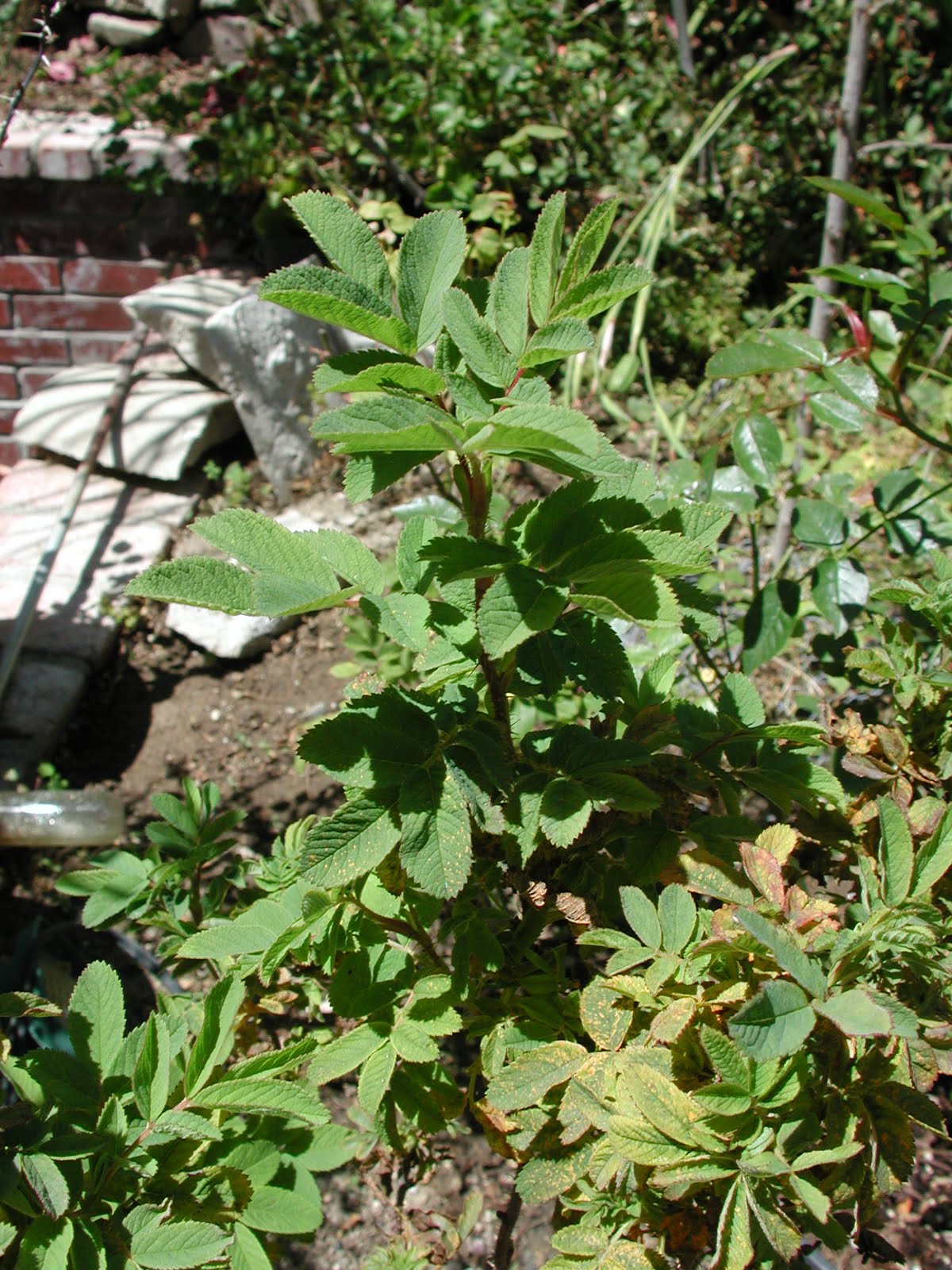

Permitting it to dry out seems to have mimicked Nature's not providing it with sufficient water in late summer and fall, causing the foliage to mature into its "old age" phase when it is most susceptible to rust infection. Rust causes what we consider premature foliage fall, but Nature's use for it is to cause the foliage to drop so the plant hardens off so it survives winter. I've been "confusing" the plant into thinking it should go into winter preparation mode, even though its growing season hasn't really happened yet.

I'm sure climatic suitability plays a part in the rust issue, too. I had observed in my old Newhall garden that Arkansana hybrids, except for Morden Blush, which was one of the most bullet-proof roses in that garden, weren't climatically suitable as they rusted very early in the season and continued rusting even when nothing else suffered the infection. A few of the Buck roses, notably Wandrin' Wind, suffered from extreme rust there, also.

Oddly, R. Arkansana "Peppermint" isn't affected by rust at all. It is planted in the ground about ten feet from the potted Arkansana, but it suffers from reflected heat and light off a white vinyl fence and has to battle asparagus fern and the resident mole, yet it grows cleanly and even flowered this spring.


Much has been written for a long time concerning the black spot susceptibility of roses bred from R. Foetida. What makes the most sense to me is genetic confusion.

Foetida is a deciduous plant. It has evolved where the greatest success requires forming its foliage early, using it up quickly, appropriate for the short growing season are it evolved in, then shedding it to prepare to winter without damage. We mixed these genes, with their associated immune system, with ever green genes from Tea and Hybrid Tea roses, which evolved in very long growing season areas. What resulted has been a line of roses which are genetically confused, with confused immune systems. The plant has instructions for creating its foliage quickly, using it up quickly so it may be shed to prepare for winter, combined with those telling it to hold that foliage the entire season. What results is foliage which quickly matures through its juvenility, rapidly becoming "senile", elderly, on a plant which refuses to shed it because the genetic information tells it to hold them like Teas and HTs do for longer growing seasons.

Rust and black spot are senility diseases, attacking "old" foliage to cause it to drop from the plant. The roses bred from Joseph Pernet's work with Foetida, those with red and yellow bi colored petals; brilliant yellows, oranges, scarlets and their blends; roses in 'tropical' colors such as shrimp, flamingo pink, "Peter Max" poster paint, neon colors, have this information programmed into them. They are the ones notorious for black spot and sometimes rust, infections.

The plants quickly form "senile" foliage, susceptible to the particular fungal attacks, much like my water stressed R. Arkansana is experiencing. We unnaturally selected roses with confused immune systems, and continue to attempt to select the better examples of that confused line in hopes of eliminating the confusion and producing healthy plants with the colors we desire. What we experience may well be not only what the plant is genetically programmed to do, but also what we unwittingly tell the plant to do through our culture, or lack of it.

Friday, June 17, 2011

New American Hulthemias due out 2012

(Clicking on the red links will take you to other sites demonstrating what is being written of. Clicking on the photos will allow viewing larger sized images for better detail.)

Hulthemia, a xerophyte native to desert regions of Iran, Afghanistan and Turkey, called "the most noxious weed in Iran" and desirable because of its characteristic red 'blotch' petal base. It's one of my prime rose "obsessions" and has been for over twenty-five years.

Rose petal bases are traditionally white or yellow. Hulthemia's is a deep, rich brick to crimson red on a bright yellow petal. Jack Harkness created four garden hybrids in England in the late 1970s and early 1980s. His company has much more recently introduced other hybrids of their breeding. None of which are available in the United States.

Mr. Harkness was a friend of Ralph Moore's, who took Harkness' work much further with his Hulthemia hybrids. I had the pleasure of suggesting the "Persian" series for their names, which is why all but Roses are Red have names beginning with Persian. I thought it appropriate because of where the species is indigenous and because two of Harkness' hybrids were named for major rivers in that area, Tigris and Euphrates. A third was named for a Persian ruler, Xerxes. The forth of their original garden hybrids was named to honor the British actor, Sir Nigel Hawthorne. I've grown all but Xerxes, which, unfortunately, appears extinct.

Mr. Moore took Hulthemia from the spring blooming only, small flowered bramble plant of the British hybrids and added vigor and repeat flowering. His Persian Autumn, Persian Sunset, Persian Flame, Persian Peach and Persian Light were introduced by Sequoia Nursery before his death. Some are still available today and are worth growing in more arid, hot areas.

Another friend of Mr. Moore's is a gentleman by the name of Dr. Jim Sproul. Dr. Sproul has worked with Hulthemia for over fifteen years, raising thousands of their seedlings each year at his Bakersfield, California home. Jim has created some very interesting, quite beautiful roses in addition to his Hulthemia hybrids. His web site, Sproul Roses is well worth browsing and following to keep up to date on his imaginative work.

Spring of 2012 sees the introduction of three of Jim's creations by Star Roses. Thrive! is a disease resistant landscape shrub bred from the Knock Out line and should be quite a good addition to the healthy landscape rose segment. His two other creations are what have me really excited!

Jim has taken the characteristic Hulthemia "blotch" and put it on real garden roses! Instead of the wispy, prickly "bramble bush", Jim's roses are real garden rose type plants with much more traditional foliage. One of the pre release plants was sent to me by a nurseryman friend, and I am impressed!

Star has created the marketing label "Eyeconic" for them to capitalize on their Hulthemia "blotch". Eyeconic Lemonade is a floribunda shrub with large, yellow with red blotch center, wonderfully fragrant flowers.


Eyeconic Pink Lemonade is similar only with pink flowers with red blotch.

The foliage on Eyeconic Lemonade is absolutely gorgeous!


So far, and it is still quite early, there are no issues with it here in Encino. Not bad for a plant which had sat in a bucket of water far too long, even began leafing out in that bucket before being mailed to me. It's just been here a few months in a two gallon can and you can see how very nice a plant it is!


Until now, Hulthemia hybrids had thin, wispy, prickly wood. Not Eyeconic Lemonade! These are thick, sturdy stems nicely clothed in very nice foliage. There are prickles but nothing like its predecessors.


If you like becoming familiar with something new, watch for Eyeconic Lemonade and Eyeconic Pink Lemonade this coming spring when Star releases them in the US. Good job, Jim! VERY good job!

Saturday, June 11, 2011

Further Warmer Weather Wraps

As I explore and experiment with this method of rooting, I'm impressed how crucial the level of moisture in the newspaper is. It must not be wet, but DAMP. You need to squeeze as much of the dripping water from it as possible or your chances of rot are significantly greater.

I've also found that the apparent optimal temperatures to hold the wrapped cuttings under is in the sixty degrees F range. Hotter and they will attempt to sprout leaves instead of callusing and rooting. Other than to use refrigeration, I have no way to test colder temperatures, but the success rate in the sixty degree F range is sufficient to not encourage me to try colder.

I wrapped two burritos of unnamed China roses three weeks ago. After two weeks, the first wrap was callused and it has been planted. Today, three weeks after wrapping, this bundle came out. Remember, you may click on any image here to see the larger version for better detail. Click on the enlarged photo for an even higher magnification.


The storage room where I'm keeping the bundles now is slightly warmer due to the increased temperatures outdoors. It is still well within the sixties optimal temperature range, but it is warmer than with the original results. You can see the range of callusing to actual root formation. These were planted this evening and watered in well.

Two weeks ago, I wrapped this bundle of the climber Shadow Dancer to see how it responds to the method at this time of year. These were the results tonight after two weeks at the slightly warmer temperature. Notice the best root formation is on the actual flower cluster. I had been taught that the actual flowering cluster wood wasn't suitable for propagation due to the lack of growth buds. However, I experimented with my Annie Laurie McDowell and several floribundas before testing this variety and have found throughout the initial experiments, this "unsuitable" wood is the fastest to form calluses and the most likely to actually form roots in the wraps. And, from experience, they DO have growth buds and will make use of them once sufficiently rooted.


With varieties such as polyanthas, most of the available wood for propagation ARE these flower clusters. Most polys don't form that many nor that long shoots with growth buds and foliage to cut without taking large sections of the plant. By using these cluster shoots, too, you increase the quantities of the plants notorious for throwing these growths you may propagate in a season, and you will likely find these are the ones to propagate fastest and easiest.  To illustrate, this is an earlier piece of a climber I wrapped and which rooted quickly. Traditionally, this is the type of wood I was taught wasn't suitable due to lack of growth buds. As you can see, it has buds.


As a further experiment, I treated and wrapped cuttings to send to a friend in another state. She wouldn't be ready for them until after June 9, so I prepared them in time to mail them and have them ready for planting a day or two after receipt. She emailed to say the thicker cuttings were nicely callused when she opened the burrito. The thinner ones weren't callusing, but turning black. It appears this method may be better suited to thicker, heavier growth with some varieties. As you can see from the above photos, at least for China roses, the gauge doesn't seem that important.

Wednesday, May 25, 2011

Warmer Weather Wrapping

To begin exploring whether cutting wrapping is successful as the weather warms and material awakens from dormancy, I wrapped two sets of cuttings two weeks ago today.

The first bunch were accidentally left soaking in a bucket of water for one week before wrapping. The bucket received half day sun for that week. As you can see from the photo, half of them rotted, while half callused.


The second batch was a large bunch of Mutabilis, freshly cut and wrapped within an hour of cutting. Two weeks from right off the plant to this.


A few are planted here while the rest are being sent to a friend for rooting. I love Mutabilis, but, realistically,  how many can I possibly use?

Tuesday, May 24, 2011

Frustration!

It doesn't take many seedlings raised before you lose a tag. Frustrating! Whether it's your own neglect, some vermin removing it as happened in my old Newhall garden where rodents were all over the hillside chaparral, or snails eating the paper tag, usually the side with the graphite on it from your documentation.

This seedling is one of the latest frustrations. I know the seed parent, the "mother", was Ralph Moore's 0-47-19, the R. Wichurana X Floradora hybrid he used for sixty years to create some remarkable roses. Who the father is, is open to conjecture. I know what I used on the seed parent. I don't have records of what failed, only what I can document was planted, and what got planted without paternal information.

I kept this seedling because of its dense, healthy foliage. It isn't as rampant a grower as some of its siblings. The wood is mahogany with mid green, semi glossy leaves. It has prickles, but not terrible ones like others of its relatives, or even its mother. It germinated last year and only began flowering for the first time a few weeks ago.


It is obvious there are Wichurana genes in the plant, all parts suggest it. I've not had a seedling from 0-47-19 show such photo reaction in the flowers. The sun touches the petal reverses, giving them a nice rosy glow. There is a flesh tone to them that suggests what I more and more suspect might be its "daddy".


I've only caught one fading flower before it fell and was thrilled to find the petal surfaces overcast with a similar rosy glow. I'll watch for these to take on that glow to be able to post photos later in an edited post.

Anyone care to go out on a limb and suggest what could be the pollen parent?

Update:

These are the same blooms one day later, and one Katydid attack later.


Monday, May 23, 2011

BUGS

Hate them. Unfortunately, they're a gardening necessity. Without them, we'd not have any birds or lizards. When you pimp pollen, you become painfully aware when they over step their bounds.

I hoped to pull some pollen from this seedling, but something beat me to it.

Fortunately, the bugger was still there so I could finally determine who the culprit was!


He was rather quick at getting away.


I figured out viewing bud identification sites it had to be a sort of Katydid. Sending the photos to Baldo Villegas, the State Entomologist, confirmed it is an immature Katydid.  Baldo has a great rose site containing many photos of diseases and insects as well as professional information concerning what to do about them. Here is the link. Baldo's bug and rose site I don't have any photos of a mature one...yet, but you can find them easily online.

Katydids can cause some real damage in your gardens. They'll eat just about anything. If you find these in your garden...


SQUASH THEM! They're Katydid eggs. They deserve to be squashed!

Saturday, May 21, 2011

Basye's Thornless Wichurana

Quite a few years ago, I purchased a rose from Sequoia Nursery they called "Basye's Thornless Wichurana". It grew..and GREW....AND GREW! As with any Wichurana, it roots at every leaf node, creating a new plant each time until it colonizes all available space. Due to lack of room, I removed it and quickly wished I hadn't. I intend to eventually begin working with it to determine if the thornless character can be bred into its hybrids.

Winter of 2004, while visiting Sequoia, I asked Ralph Moore if he still had the plant and might he please have one available for sale? He didn't but told me he'd make some. The following summer, May 29, I was in Visalia to attend the dedication of his memorial garden. People lined up to shake the great Rose Man's hand. Many of us wore name tags with our names, the names of our roses he'd created and named for us, as we slowly moved toward the honorees seat.

As I approached him, he caught sight of me out the corner of his eye and reached for my hand. Jerking medown to his face to be heard, he asked, "You know that thornless Wichurana you asked me for last winter? I got two little plants for you if you remind me when we go back to the nursery". Easily six months since my inquiry, with the dedication of his memorial garden with its associated hullabaloo, and this 97 year old gentleman is focused on my inquiry of six months ago! That's the source of my two plants of Basye's Thornless Wichurana.

It still grows and grows. These plants have been starved in depleted soil, crammed into five gallon nursery cans, yet they STILL grow! One has thrown itself through the other roses in the pot ghetto, into a huge Manetii root stock which got away, and cascades down the sunny side of the mound. Laterals spring from its smooth canes, each terminating in clusters of single, white flowers.

The foliage is attractive, and I noticed today it has the trait of "tanning" to red in heat and sun, particularly on the reverses of the foliage.


The canes ARE thornless. The leaf mid ribs do have small, hooked prickles. The plant roots EXTREMELY easily and GROWS quite well. It should easily make a very successful ground cover for a slope, rooting as it creeps along the ground. Not having the flesh eating prickles on the canes should help make it quite a bit easier to deal with when having to pull weeds or trash from the plant. When it flowers, it is quite beautiful.


Catching the fragile flowers while they are still fresh and without damage is quite a trick. Unfortunately, I can't detect much scent from them.  What I did notice today during an overcast, warmish morning is a slight "soapy" scent.

Strangely, the stipules are slightly fringed like the bracts in the flower clusters, a trait indicative of multiflora heritage. No other Wichurana or its hybrids not containing multiflora I've encountered possess the fringing.


Cuttings of this easily rooted, healthy rose are available to anyone interested within the Continental US for the cost of postage.