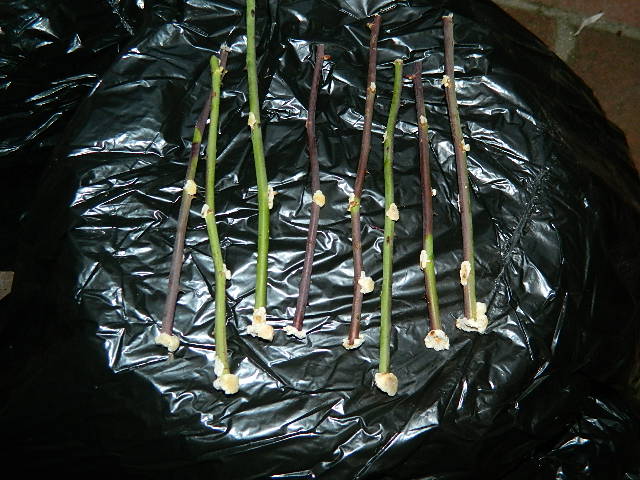
It appears I goofed.... I wanted to be sure I had sufficient cuttings succeed, so I wrapped a LOT of each one. They have ALL taken! I guess I should have checked them last week so there would be more time to beg empty bands from friends so these could be planted when they should be planted. Too late now! More to follow as the other six, large bundles get unwrapped and planted in the next several days...
Tuesday, January 28, 2014
Tuesday, January 21, 2014
First 2014 Wraps
The weather and plant conditions appear to finally be appropriate for callusing. I've wrapped a few earlier batches to test the conditions and create some examples to use for the presentations I've given for local rose societies, but none had produced the results I discovered yesterday when these were unwrapped.
The variety is an experimental seedling Ralph Moore created some years ago. He pollinated Golden Angel, a lovely Wichurana based yellow mini he created with what he grew as R. Soulieana. What makes this a special hybrid is, the Soulieana Mr. Moore grew produces repeat flowering seedlings in the first generation. Traditionally, it requires several more generations to get repeat flowering from most species, and particularly from Soulieana. This one apparently carries and transmits repeat in one generation as this is most definitely a hybrid.
These cuttings hadn't callused as well as I'd hoped after their first thirteen days in the wraps. I checked, in hopes there were ones I could use for examples for a demonstration I presented that evening. Nope. None were sufficiently along to sacrifice. Fast forward three days...wow! These were all unwrapped Sunday, the 20th and planted.
Notice how even the slight amount of cambium exposed by breaking the prickle free from the bark produced callus.
Every source of exposed cambium began callusing.
The variety is an experimental seedling Ralph Moore created some years ago. He pollinated Golden Angel, a lovely Wichurana based yellow mini he created with what he grew as R. Soulieana. What makes this a special hybrid is, the Soulieana Mr. Moore grew produces repeat flowering seedlings in the first generation. Traditionally, it requires several more generations to get repeat flowering from most species, and particularly from Soulieana. This one apparently carries and transmits repeat in one generation as this is most definitely a hybrid.
These cuttings hadn't callused as well as I'd hoped after their first thirteen days in the wraps. I checked, in hopes there were ones I could use for examples for a demonstration I presented that evening. Nope. None were sufficiently along to sacrifice. Fast forward three days...wow! These were all unwrapped Sunday, the 20th and planted.
Notice how even the slight amount of cambium exposed by breaking the prickle free from the bark produced callus.
Every source of exposed cambium began callusing.
Roots actually began forming in three days!
Monday, March 4, 2013
More Whip Wraps for Standard Trunks
Those exposed to the deepest cold, callused the fastest and best. Those from more moderate weather situations developed less callus. Also interestingly, when the outdoor temperatures were in the sixties and seventies, the results were less dramatic. When we experienced the week of eighties and near ninety degree temperatures, the cuttings callused heavily and quite quickly. I removed a batch after ten days which had callused quite heavily.
I wouldn't have expected the outdoor temperature to have had such a dramatic effect on wraps held inside the house with the thermostat set at a continuous 68 degrees F, but it did!
These cuttings are from two varieties, both of which I intend to use to bud standards, or tree roses. The first is a seedling I raised a number of years ago from a cross I knew had to result in something neat. I used Ralph Moore's yellow climbing miniature breeder, 1-72-1 as the seed parent with pollen from Tom Carruth's wonderful shrub, Midnight Blue expecting something hopefully without prickles (or very few) and with strong coloring. I raised a very vigorous climber with lovely foliage and very few prickles...and absolute no flowers in over eight years. So, I decided to try it as a root stock to see how it might work. The wood is very strong, and as you can see from the photos, it calluses extremely well!
These are the two wraps with the long whips in them.
This is the 1-72-1 X Midnight Blue material after two weeks in the house. Notice how it has also callused from the wounds where I disbudded it to prevent suckers.
A few had already begun throwing small roots from the calluses.
Close up of the callused ends.
The other variety I am using for standard trunks, I've used before with very good results. I have a standard of Baby Faurax which I budded on Cardinal Hume in 1994 and it's still going strong. These are shorter pieces of Cardinal Hume I will use to bud bushes with.
The two longer whips also callused very well.
Even from the disbudding wounds, like the seedling did. The purple coloring to the canes isn't disease, but the coloring this variety normally develops in my garden at this time of year.
The callus isn't discolored due to rot, but discolored because it had adhered to the newspaper and absorbed inks from it.
The longer whips are all wrapped in white plastic trash bag strips and potted to continue rooting. To review how to wrap longer cuttings in white plastic to prevent them from drying out while rooting, please see the previous entry here about rooting longer cuttings.
I plan on using these to bud the shorter polyanthas out back, in hopes of protecting them from being mowed down by the rabbits who refuse to leave them alone. There are also two smaller ground cover varieties I wish to use for breeding which don't lend themselves easily to my space grown on the ground. Hopefully, by creating shorter weeping standards of them, I will be able to grow and use them more easily. I'm keeping my fingers crossed!
Sunday, January 20, 2013
There Really IS a Difference in Newspaper Quality
No, not a comment about the contents of what's inside the paper, but the actual paper itself. I demonstrated the wrapping method of propagation for a local rose society this week. The members were encouraged to bring in their cuttings and newspaper so we could process them together. I was a bit surprised when I began wringing out the wet newspaper and found their local paper fell apart like dryer lint! No matter how many sheets of paper I put together, it fell apart during the wringing part. It wasn't me, as I had brought my own papers with me, The Wall Street Journal and USA Today. Not that those are what I read, as I don't. They are what are made available to me by friends who do read them. Both papers hold up perfectly when wet and wrung out to produce the damp paper to wrap the cuttings.
So, if you're experiencing difficulties with getting your wrapping paper squeezed out, you might consider the possibility that the actual paper your newspaper uses isn't as durable as some others. You might find it worthwhile picking up a Sunday paper, or two, of ones I've mentioned, or, better yet, make a friend who reads them and won't mind passing them on to you!
Wednesday, September 19, 2012
I think I bit off more than I can chew...
This pollinating year started very slowly. I planned on using Banksiae lutescens on anything which flowered at the proper time. The problem was, it remained pretty cool for the longest time. That was great for Lutescens, but bad for everything else. Nothing cooperated and I feared I would have to be satisfied using it with the trusty Queen Elizabeth out back.
The right weather seemed to happen over night, as if someone flipped the switch. What I wanted to put the pollen ON, began flowering with the pollen donors. I was off like a shot!
I knew many wouldn't take, as that's just the nature of the beast. I also knew I would lose many to the various "free loaders" who traditionally visit my roses. Some didn't take, and some were used as smorgasbord fodder, as expected, but many more succeeded than I expected!
I began harvesting hips earlier than I normally would, in hopes of my collecting the fruit of my labors before the free loaders did, and I succeeded rather well! It seems, quite a bit better than I possibly should have... There are still about three dozen crosses left maturing (potentially being eaten) through the roses, but I have collected some 185 deliberate crosses of my own; only four "self" set crosses and two types which were graciously shared with me of things I wanted to try. That is a whale of a of rose seeds!
I know there is no way I am going to find room to plant them all. There is a real limit to suitable places to create seedling raising areas, as well as a definite limit to space where they can be grown on, so some difficult decisions lie ahead. But, there really aren't any deliberate crosses I'm not interested in seeing the results of. How would anyone choose which NOT to explore?
The right weather seemed to happen over night, as if someone flipped the switch. What I wanted to put the pollen ON, began flowering with the pollen donors. I was off like a shot!
I knew many wouldn't take, as that's just the nature of the beast. I also knew I would lose many to the various "free loaders" who traditionally visit my roses. Some didn't take, and some were used as smorgasbord fodder, as expected, but many more succeeded than I expected!
I began harvesting hips earlier than I normally would, in hopes of my collecting the fruit of my labors before the free loaders did, and I succeeded rather well! It seems, quite a bit better than I possibly should have... There are still about three dozen crosses left maturing (potentially being eaten) through the roses, but I have collected some 185 deliberate crosses of my own; only four "self" set crosses and two types which were graciously shared with me of things I wanted to try. That is a whale of a of rose seeds!
I know there is no way I am going to find room to plant them all. There is a real limit to suitable places to create seedling raising areas, as well as a definite limit to space where they can be grown on, so some difficult decisions lie ahead. But, there really aren't any deliberate crosses I'm not interested in seeing the results of. How would anyone choose which NOT to explore?
| (IHT X LB) | X | (LT X CD) X Lutescens |
| (IHT X LB) | X | 42-03-02 |
| (IHT X LB) | X | 86-3 |
| (IHT X LB) | X | April Mooncrest |
| (IHT X LB) | X | Art Nouveau |
| (IHT X LB) | X | Blue for You |
| (IHT X LB) | X | Gloria Mundi |
| (IHT X LB) | X | Indian Love Call |
| (IHT X LB) | X | L56-1 |
| (IHT X LB) | X | Pookah |
| (IHT X LB) | X | Pretty Lady |
| (IHT X LB) | X | Rayon Butterfed |
| (IHT X LB) | X | Secret Garden |
| (IHT X LB) | X | Tom Thumb |
| ? | X | April Mooncrest |
| 0-47-19DLFED | X | 1-72-1Hugonis |
| 0-47-19DLFED | X | April Mooncrest |
| 0-47-19DLFED | X | Comtesse du Cayla |
| 0-47-19DLFED | X | Gloria Mundi |
| 0-47-19DLFED | X | Indian Love Call |
| 0-47-19DLFED | X | Joyberry |
| 0-47-19DLFED | X | Lynnie |
| 0-47-19DLFED | X | Rayon Butterfed |
| 0-47-19DLFED | X | Secret Garden |
| 0-47-19DLFED | X | Sweet Nothings |
| 0-47-19DLFED | X | Walferdange |
| 0-47-19DLFED | X | Wild Dancer |
| 0-47-19POO | X | Tom Thumb |
| 1-72-1DLFED | X | Hugonis |
| 1-72-1DLFED 8 | X | Comtesse du Cayla |
| 1-72-1DLFED 8 | X | Secret Garden |
| 1-72-1DLFED 9 | X | Rayon Butterfed |
| 1-72-1Hugonis | X | (IHT X LB) |
| 1-72-1Hugonis | X | Astra |
| 1-72-1Hugonis | X | Comtesse du Cayla |
| 1-72-1Hugonis | X | DLFED 4 |
| 1-72-1Hugonis | X | Doc |
| 1-72-1Hugonis | X | First Impression |
| 1-72-1Hugonis | X | Golden Wings |
| 1-72-1Hugonis | X | Indian Love Call |
| 1-72-1Hugonis | X | Joyberry |
| 1-72-1Hugonis | X | L56-1 |
| 1-72-1Hugonis | X | Lilac Charm |
| 1-72-1Hugonis | X | Magic Wand |
| 1-72-1Hugonis | X | Mrs. Charles Bell |
| 1-72-1Hugonis | X | Open Arms |
| 1-72-1Hugonis | X | Purpurea |
| 1-72-1Hugonis | X | Rayon Butterfed |
| 1-72-1Hugonis | X | Secret Garden |
| 1-72-1Hugonis | X | Self |
| 1-72-1Hugonis | X | Tom Thumb |
| 1-72-1Hugonis | X | Wild Dancer |
| 42-03-02 | X | 86-3 |
| 42-03-02 | X | Hugonis |
| April Mooncrest | X | First Impression |
| April Mooncrest | X | Gardens of the World |
| April Mooncrest | X | Joyberry |
| April Mooncrest | X | Porcelain Rose |
| April Mooncrest | X | Rayon Butterfed |
| Art Nouveau | X | Art Nouveau |
| Astra | X | Muriel |
| Blue for You | X | Blue for You |
| Cal Poly | X | ? |
| Cal Poly | X | 1-72-1Hugonis |
| Cal Poly | X | 42-03-02 |
| Cal Poly | X | 42-03-02 |
| Cal Poly | X | 81-02-09 |
| Cal Poly | X | 86-3 |
| Cal Poly | X | April Mooncrest |
| Cal Poly | X | Blue for You |
| Cal Poly | X | Cecil |
| Cal Poly | X | Cineraire |
| Cal Poly | X | Gardens of the World |
| Cal Poly | X | Gina's Rose |
| Cal Poly | X | Little Butterfly |
| Cal Poly | X | Lutescens |
| Cal Poly | X | Lynnie |
| Cal Poly | X | Maytime |
| Cal Poly | X | Minutifolia |
| Cal Poly | X | Porcelain Rose |
| Cal Poly | X | Pretty Lady |
| Cal Poly | X | Purpurea |
| Cal Poly | X | R. Fedtschenkoana |
| Cal Poly | X | Rayon Butterfed |
| CPDLFED 3 | X | Rayon Butterfed |
| CPDLFED2 | X | Secret Garden |
| CPDLFED3 | X | Joyberry |
| DLFED 1 | X | Rayon Butterfed |
| DLFED 3 | X | 1-72-1Hugonis |
| DLFED 3 | X | Rayon Butterfed |
| DLFED 3 | X | Secret Garden |
| DLFED 3 | X | Wild Dancer |
| DLFED 3 | X | DLFED 3 |
| DLFED 4 | X | DLFED 4 |
| DLFED 4 | X | Rayon Butterfed |
| Eyeconic Lemonade | X | Eyeconic Lemonade |
| Eyes for You | X | Gardens of the World |
| Eyes for You | X | Lynnie |
| First Impression | X | ? |
| First Impression | X | 1-72-1Hugonis |
| First Impression | X | April Mooncrest |
| First Impression | X | Art Nouveau |
| First Impression | X | Blue for You |
| First Impression | X | Gardens of the World |
| First Impression | X | Grey Pearl |
| First Impression | X | L56-1 |
| First Impression | X | Lutescens |
| First Impression | X | Rayon Butterfed |
| First Impression | X | Sweet Nothings |
| Gardens of the World | X | L56-1 |
| Gina's Rose | X | ? |
| Gina's Rose | X | R. Minutifolia |
| Golda Banks | X | 1-72-1Hugonis |
| Golda Banks | X | Lamarque |
| Golda Banks | X | Lutescens |
| Golden Horizon | X | 1-72-1Hugonis |
| Grey Pearl | X | Lamarque |
| I03-4-5 | X | I03-4-5 |
| Indian Love Call | X | 1-72-1Hugonis |
| Indian Love Call | X | April Mooncrest |
| Indian Love Call | X | Blue for You |
| Indian Love Call | X | DLFED4 |
| Indian Love Call | X | Lutescens |
| Indian Love Call | X | Morcrest |
| Indian Love Call | X | Orastarmag |
| Indian Love Call | X | Rayon Butterfed |
| Indian Love Call | X | Secret Garden |
| Kordes Brilliant | X | Joyberry |
| Kordes Brilliant | X | Tom Red |
| L56-1 | X | 1-72-1Hugonis |
| L56-1 | X | Basye's Thornless Wichurana |
| L56-1 | X | Cal Poly |
| L56-1 | X | Comtesse du Cayla |
| L56-1 | X | IHTLB |
| L56-1 | X | Indian Love Call |
| L56-1 | X | Lamarque |
| L56-1 | X | Minutifolia |
| Lilac Charm | X | DLFED 4 |
| Lynneraire | X | Lynneraire |
| M37-1 | X | ? |
| Maytime | X | 1-72-1Hugonis |
| Maytime | X | Centre Stage |
| Maytime | X | DLFED 4 |
| Maytime | X | Lutescens |
| Maytime | X | Golda Banks |
| Mrs. Charles Bell | X | 1-72-1Hugonis |
| Old Master | X | Muriel |
| Old Master | X | Tom Red |
| Picasso | X | Muriel |
| Picasso | X | Tom Red |
| Pink Gate | X | 1-72-1Hugonis |
| Pink Petticoat | X | 1-72-1Hugonis |
| Pink Petticoat | X | 42-03-02 |
| Pink Petticoat | X | 86-3 |
| Pink Petticoat | X | Blue for You |
| Pink Petticoat | X | L56-1 |
| Pink Petticoat | X | Lamarque |
| Pink Petticoat | X | Lutescens |
| Pink Petticoat | X | MInutifolia |
| Pink Petticoat | X | R. Fedtschenkoana |
| Pink Petticoat | X | Sweet Nothings |
| Porcelain Rose | X | Porcelain Rose |
| Pretty Lady | X | ? |
| Pretty Lady | X | Gina's Rose |
| Pretty Lady | X | Lynnie |
| Pretty Lady | X | Maytime |
| Queen Elizabeth | X | Lutescens |
| Queen Elizabeth | X | R. Minutifolia |
| Show'n Tell | X | Rayon Butterfed |
| Show'n Tell | X | Tom Red |
| Sunburn | X | 1-72-1Hugonis |
| Sunburn | X | Lutescens |
| Sunburn | X | Porcelain Rose |
| Sunburn | X | R. Fedtschenkoana |
| Sunburn | X | Rayon Butterfed |
| Sweet Nothings | X | 1-72-1Hugonis |
| Sweet Nothings | X | 42-03-02 |
| Sweet Nothings | X | 81-02-09 |
| Sweet Nothings | X | Annie Laurie McDowell |
| Sweet Nothings | X | Blue for You |
| Sweet Nothings | X | Cal Poly |
| Sweet Nothings | X | Ebb Tide |
| Sweet Nothings | X | First Impression |
| Sweet Nothings | X | Joyberry |
| Sweet Nothings | X | L56-1 |
| Sweet Nothings | X | Lamarque |
| Sweet Nothings | X | Peace |
| Sweet Nothings | X | Rayon Butterfed |
| Tom Brown | X | Tom Brown |
| White Cecil Brunner | X | Pink Petticoat |
| Xanthina | X | Xanthina |
Subscribe to:
Posts (Atom)