Friday, May 9, 2014

Continuing obsession...

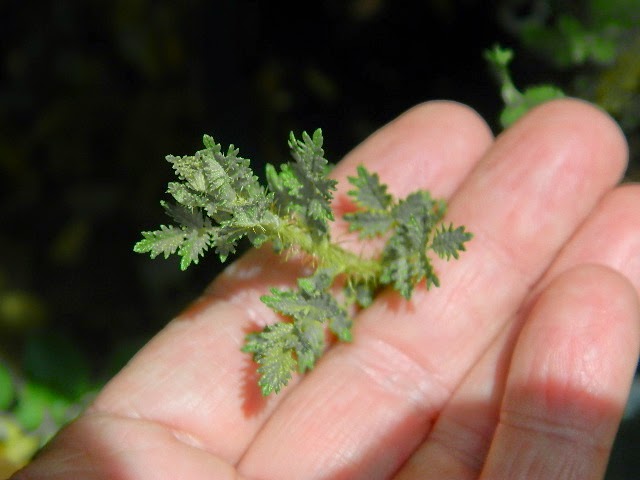
R. Minutifolia is one of the most beautiful and interesting roses I have encountered. It's unlike any other, with its tiny foliage and how it "hop scotches" across the ground instead of suckering. 


After a cane has flowered, it bends over to touch the ground, much like a peanut plant. Once the tip contacts suitable soil, it roots, "hop scotching" across the ground. 

Minutifolia is completely healthy in the two areas I've grown it. Reportedly, it dislikes summer water, however I've had great success growing it in the ground as well as five gallon nursery containers in standard potting soil, providing it with the same water levels and frequencies I've provided all the other roses. This rose goes summer dormant. The tiny foliage and bristles permit it to capture moisture from the fogs. When moisture becomes truly scarce, the foliage dries up and is shed, reducing the water needs of the plant until the rains or fogs return. 

There are supposedly two, distinct forms of the species. The most commonly available is the San Diego form which has been propagated from the stand naturally occurring on Otay Mesa in San Diego County. It seldom sets seeds, appearing to be self sterile and possibly female sterile as well. It has refused every pollen I have ever placed on it. The other form is from the stand naturally occurring in Mexico. The Mexican form reportedly sets seed quite well. 

I've worked with R. Minutifolia for far too many years to count by now. Seeds have been generated, a few have actually germinated, yet none have survived. I've most frequently used its pollen to pollinate blooms on miniatures and the more fertile floribundas I prefer to use as seed parents. This year, I've even attempted to pollinate R. Fedtschenkoana with Minutifolia's pollen. 

Working with these tiny, prickly buds can be rather "frustrating". They're difficult to hold on to because they are so small to begin with. Add the bristles on the ovaries which make them incredibly slippery and you can imagine what it's like to collect pollen from a large quantity of them. Fortunately, or unfortunately, my four plants seldom provide "large" numbers of buds at one time. 


Finding these tiny buds among the minute foliage can be quite difficult. 

It isn't as difficult when they appear at the terminal ends of the canes as it is when they hide among the tiny leaves along the canes. 

The batch of buds pictured above finally provided their harvest after more than half an hour of "micro surgery". After two days of air drying on a piece of paper, it was back out in the garden to spread their golden dust in this year's attempts at finally raising seedlings containing their genes. Wish me luck!


Saturday, May 3, 2014

Interesting, and pretty results from a "what if?" cross

April Mooncrest is my crested seedling combining Ralph Moore's crested work with Griffith Buck's shrub roses. Pookah is a multiflora based polyantha which performs in my conditions much better than most others. It impresses me as a darker pink, more controlled growth, healthier Ballerina which never suffers chlorosis here. What happens when you cross the two? 

It appears to want to climb, which doesn't surprise me. It repeats its flowers, which I would expect as both parents flower fairly continuously here. I figured the foliage would be healthy, coming from two very healthy parents. It is, but it's also wonderfully pigmented. 

When still a rather new seedling, it impressed me with its purple toned foliage, scent, health and vigor.


The bloom is just a double pink, not bad, but not exceptional.


But, when fall began, the whole plant turned bronze, apricot and red tones! Wood and foliage both expressed the most wonderful coloring. 


Now in its second summer, it's starting to show what appears to be climbing growth. It's also beginning to demonstrate some more decorative sepals. It continues producing healthy, beautiful foliage and that's what counts. 


Friday, May 2, 2014

What a difference some days make!

In my last post, I'd questioned if a seedling was one I had seen flowering last fall. Since then, it has been potted into the next size larger can and fed. Now there are two buds about to open and one open flower. Keep in mind it has been mid nineties to low triple digits here for the past three days. Humidity during the day has been single digit and the wind has been pretty constant any time the sun has shone. The cross is a very healthy mini breeder Jim Sproul shared with me, using pollen from my 1-72-1Hugonis hybrid. I'm very pleased with what I see so far! There are definitely some Hugonis genes in the plant and it repeats!


Tuesday, April 8, 2014

I wonder if this is the same seedling?

I've been using pollen from my 1-72-1Hugonis seedling all over the garden both last year and this. One of the most successful crosses resulted from putting its pollen on a rose Jim Sproul shared with me he calls L56. It's an involved cross containing his Thrive!, so it contains "good genes" for health. L56 has quite healthy, glossy, dark foliage with a deeply saturated, bright red single flower.

1-72-1Hugonis has single yellow flowers with heavily embossed, matte, medium green foliage. It's also completely disease free in my garden.

Only one seedling from this cross flowered its first year. It battled very adverse conditions but survived. I was thrilled and amazed to see it flower so quickly after germination. 

 Now, I'm wondering if this seedling, which I found in flower today, is the early flowering seedling from last year.


I believe it shows signs of hybridity in the foliage. It's definitely one of the least vigorous of the batch. L56's foliage is quite glossy and traditionally produces five leaflets. 

1-72-1Hugonis has heavily embossed, matte foliage and expresses nine to thirteen leaflets. 

Notice this seedling produces both seven and five leaflets, is more matte and quite embossed.


I don't know if it will increase in vigor with maturity, but it will definitely be interesting to watch. 

Monday, March 10, 2014

Raspberry Kiss (Eyes on Me)

Christopher Warner appears to have done it again! He seems to be able to crank out healthy, beautiful roses at will. I'd lusted for Eyes on Me on line for the longest time. Discovering Certified Roses in Texas imported and has begun distributing it to Lowe's stores led me to my only retail rose hunt of the year. I purchased a pulp potted Raspberry Kiss (Certified's American name for Eyes on Me) from my local Lowe's for a whopping $9.99. A lusty, husky, healthy, apparently budded, new British hybrid Hulthemia in a pot for $10. What could be better?

I expected it to have nice foliage, being bred from Len Scrivens' seedling, SCRIVbell. Not much is known about the rose, except it has also been used to create such noteworthy, healthy, beautiful roses as Blue for You and Bull's Eye. Per the Royal National Rose Society's article in 2013, it appears from the roses used to create Eyes for You, it is also related. 

The plant appears to be created from plastic holly. It's throwing flower buds at nearly every twig tip, and they're opening! Take a look at these leaves. They look good enough to eat! 


I didn't allow the first bud to open by itself as I had pollen I simply HAD to use on something and this was the only rose even close to ready. But, number two opened today and WOW!


Compared to the larger flowered types such as Jim Sproul's Eyeconic Lemonade and Eyeconic Pink Lemonade, these are on the small size.

The "blotch" is intense. I noticed it has an unusual texture where the petals attach to the top of the ovary which gives an interesting "cross" effect to the open flower. You can see it much more easily in the petals after I removed them from the bloom.


This is something I've not noticed in any other Hulthemia hybrid, much less any other rose. It is an interesting facet to the flower. 

Stamen color can vary greatly in roses generally, in Hulthemia hybrids, they can be strikingly dramatic. Raspberry Kiss's stamen are particularly beautiful. I've not observed any others which graduate from nearly yellow, through nearly red to an almost blackish-brown. They are gorgeous! 


I'm eager to see how this performs as the season progresses, but can already see it may be one of the better $10 garden purchases of the past several seasons. Stay tuned!